

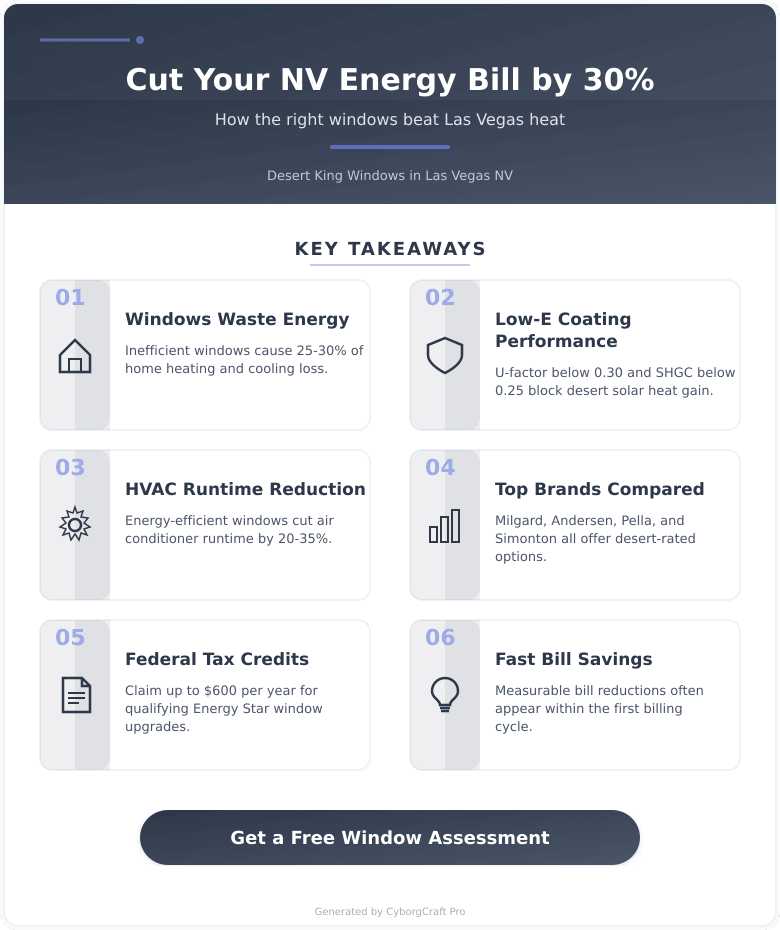
Why Your NV Energy Bill Is Still Over $350 a Month – And How the Right Las Vegas Windows Can Cut It by 30% Before This Summer
Energy-efficient window replacement is the process of swapping single-pane or aging double-pane windows for high-performance units engineered to block solar heat gain and reduce HVAC load. For Nevada homeowners, this single upgrade consistently ranks as one of the fastest ways to lower monthly utility costs in a desert climate.
This guide focuses specifically on how North Las Vegas and greater Clark County homeowners can cut NV Energy cooling bills before the 2025 summer peak using the right window products and installation approach.
Energy-Efficient Window Replacement Definition: The installation of windows with low U-factor ratings, low-E coatings, and low solar heat gain coefficient (SHGC) values designed to minimize heat transfer and reduce mechanical cooling demand in hot-climate homes.
Why Nevada Homes Lose So Much Money Through Their Windows
Here’s the thing most homeowners don’t realize: your air conditioner isn’t the problem. Your windows are letting the work it does escape right back outside.
According to the U.S. Department of Energy, inefficient windows account for 25-30% of residential heating and cooling energy use. In a climate like Las Vegas, where summer temperatures regularly push past 110°F, that percentage skews even higher. Single-pane windows have a U-factor around 1.2. A quality Energy Star-certified window for hot climates carries a U-factor below 0.30 and an SHGC below 0.25, which means dramatically less heat entering your living space.
The most common mistake we see is homeowners running their HVAC harder instead of addressing the source. Replacing four to eight windows in your home’s sun-facing exposures often delivers measurable bill reductions within the first full billing cycle after installation.
Energy-Efficient Windows vs. Standard Windows: Which Approach Works?
Where energy-efficient windows succeed: They block infrared radiation before it enters your home, reduce HVAC runtime by 20-35%, cut UV damage to flooring and furniture, and improve indoor comfort near window walls.
Where energy-efficient windows fall short: Upfront cost is higher than basic replacement windows. In homes with significant air sealing issues elsewhere, savings may be partially offset until those problems are addressed.
Where standard replacement windows succeed: Lower upfront cost, faster lead times, and acceptable performance in mild climates.
Where standard windows fail: In Nevada heat, standard double-pane windows without low-E coating still allow significant solar heat gain. They rarely qualify for federal tax credits or NV Energy rebate programs.
The verdict: For any Nevada homeowner paying over $300 monthly on NV Energy bills during summer, energy-efficient windows with low-E coating and a certified SHGC below 0.25 deliver measurable ROI that standard windows simply cannot match in this climate.
2025 Window Brand Comparison for Las Vegas Homeowners
BrandProduct LinePrice Per Window (2025)U-FactorSHGCWarrantyBest ForAndersen100 SeriesContact for current pricing0.270.2120-yearMid-range valueMilgardTuscany SeriesContact for current pricing0.250.23LifetimeDesert climatesPella250 Series$380 – $7000.260.22Limited lifetimeBalanced performanceSimontonReflections 5500$300 – $5500.280.24LifetimeBudget-consciousWincore8000 Series$280 – $5000.290.25Limited lifetimeHigh-volume replacement
Thinking about which product fits your home and budget? Contact us for a no-pressure walkthrough of your options. We’ll tell you exactly what makes sense for your specific exposure and square footage.
Nevada Tax Credits and Utility Rebates Available in 2025
Federal Energy Efficient Home Improvement Credit: Up to $600 per year for qualifying exterior windows and skylights (2025 limits). Windows must meet Energy Star Most Efficient criteria for your climate zone.
NV Energy Rebate Program: NV Energy’s residential energy efficiency rebate program offers incentives for qualifying window replacements. According to Energy Star, Nevada falls in Climate Zone 3, requiring SHGC at or below 0.25 for hot-climate certification.
Nevada homeowners who combine federal credits with NV Energy rebates may meaningfully reduce their effective out-of-pocket installation cost. Contact your installer and utility provider for current program details and eligibility requirements.
Your Window Replacement Action Plan
- Step 1 – Audit Your Exposures: Walk your home and identify south- and west-facing windows. These receive maximum afternoon sun and drive the highest heat gain. Prioritize these first for maximum bill impact.
- Step 2 – Verify Product Specs: Confirm any window you select carries an SHGC below 0.25 and U-factor below 0.30 for Nevada’s climate zone. Ask for the NFRC label documentation.
- Step 3 – Get a Licensed Contractor: Nevada Revised Statutes require window installers to hold a current Nevada State Contractors Board license. Verify at nvcontractorsboard.com before signing anything.
- Step 4 – Confirm Permit Requirements: Clark County requires building permits for full-frame window replacements. Insert replacements may qualify for a simplified permit process – confirm with your contractor.
- Step 5 – File for Credits: Save your itemized receipt and product spec sheet. You’ll need these for IRS Form 5695 to claim your federal credit on your 2025 tax return.
Pre-Installation Checklist
- ☐ Confirm Nevada contractor license number with the Nevada State Contractors Board
- ☐ Request proof of general liability and workers’ compensation insurance
- ☐ Verify NFRC-rated specs (U-factor and SHGC) on product data sheet
- ☐ Confirm Energy Star certification for Climate Zone 3
- ☐ Secure building permit before installation begins
- ☐ Save itemized invoice for federal tax credit filing
Common Mistakes That Kill Your Savings
Mistake 1 – Choosing Windows by Price Alone: A cheaper window with a high SHGC will underperform in Nevada heat. The rating on the label matters more than the sticker price in a desert climate.
Mistake 2 – Skipping South and West Exposures: Replacing only easy-access windows while ignoring sun-facing walls leaves most of your savings on the table.
Mistake 3 – Using an Unlicensed Installer: Improper installation creates air gaps that negate the window’s thermal performance entirely. Always verify Nevada contractor licensing before signing.
Key Takeaways for Nevada Homeowners in 2025
- Windows cause 25-30% of cooling loss – addressing them directly is more effective than running your AC harder
- Low-E, low-SHGC windows are non-negotiable in Nevada’s Climate Zone 3 for real bill reductions
- Federal credits up to $600 apply in 2025 for qualifying Energy Star-certified products
- Prioritize south and west exposures first for the fastest return on your investment
- Licensed Nevada installers are required for code-compliant, warranty-valid work
Frequently Asked Questions
How much can new windows actually reduce my NV Energy bill?
Homeowners in hot climates typically see cooling cost reductions of 20-30% after replacing inefficient windows with Energy Star-certified products. Results vary based on how many windows are replaced and their solar exposure, but south- and west-facing replacements deliver the fastest measurable impact in Nevada summers.
What window specs do I need for Nevada’s climate?
For Nevada’s Climate Zone 3, look for windows with a U-factor at or below 0.30 and an SHGC at or below 0.25. These ratings are printed on the NFRC label attached to every certified window unit and determine both performance and eligibility for rebates and tax credits.
Do I need a permit to replace windows in Clark County?
Full-frame window replacements in Clark County generally require a building permit. Insert or pocket replacements may qualify for a simplified process – confirm the requirement with your licensed contractor before work begins to avoid code compliance issues.
How long does window replacement take?
Most residential window replacement projects in the Las Vegas area take one to three days depending on the number of units. Custom-sized or special-order windows may require a 3-6 week lead time before installation day.
What is a low-E coating and why does it matter in Nevada?
Low-E (low-emissivity) coating is a microscopic metallic layer applied to window glass that reflects infrared heat before it passes through the pane. In Nevada’s intense solar environment, this coating is the single most important factor in reducing heat gain and protecting your indoor comfort all summer.
Can I claim a tax credit for window replacement in 2025?
Yes, the federal Energy Efficient Home Improvement Credit allows up to $600 for qualifying windows installed in 2025, claimed on IRS Form 5695. Windows must carry Energy Star Most Efficient certification for your climate zone to qualify.
The Bottom Line for North Las Vegas Homeowners
Summer 2025 is coming fast. The best time to address your windows is before peak cooling season drives your bill past $400 a month. At Desert King Windows in Las Vegas NV, we help homeowners throughout North Las Vegas, Henderson, Summerlin, and surrounding Clark County communities find the right window solution for their home, budget, and climate.
Ready to see exactly how much you could cut from your monthly energy bill? Contact us today for a straight-talking estimate and real answers – no pressure, no upsell, just honest guidance on what will actually work for your home.
About the Author
The Desert King Windows Team, window replacement professionals serving North Las Vegas, NV and the greater Clark County area. For more about our approach, visit our homepage or explore our services.
Recent posts
 Vinyl vs. Fiberglass Windows in Arizona: An Honest Desert ComparisonSeptember 28, 2026
 Why Vinyl Windows Are the Smart, Low-Maintenance Choice for Las Vegas HomesSeptember 25, 2026
 Entry-Door Replacement in Phoenix: Curb Appeal That Can Take 115 DegreesSeptember 21, 2026
 The Federal Window Tax Credit Ended – How Las Vegas Homeowners Can Still Save in 2026September 18, 2026