
This guide focuses specifically on Low-E glass performance for Arizona desert homeowners dealing with extreme UV exposure, triple-digit heat, and sky-high cooling bills.
Low-E Glass Definition: Low-emissivity (Low-E) glass is a window glazing product treated with a thin metallic oxide coating that reduces heat transfer through the glass by reflecting solar infrared radiation before it enters or exits a building.
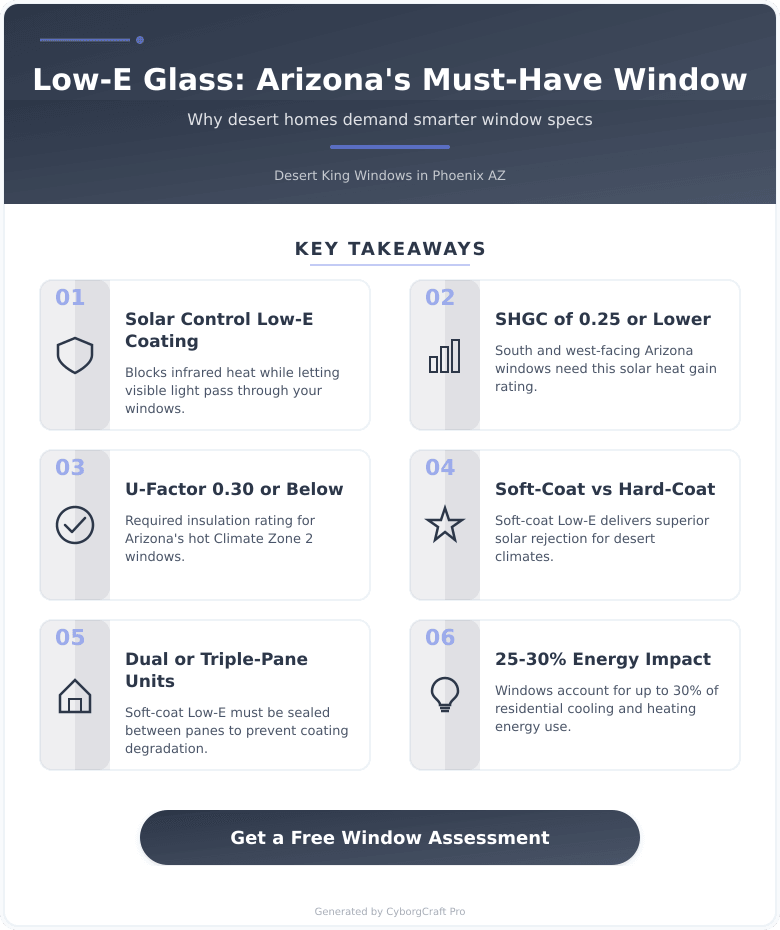
Most of the country treats Low-E glass as a nice upgrade. Here in Phoenix, it is closer to a structural necessity. The U.S. Department of Energy reports that heat gain and heat loss through windows accounts for 25-30% of residential heating and cooling energy use nationally. Phoenix receives about 299 sunny days per year, but specific window heat gain percentage for Arizona is not dramatically higher per available DOE data.
At Desert King Windows in Phoenix AZ, we see this play out constantly. Homeowners near 2615 S 21st St, Phoenix, AZ 85034 are replacing windows that simply were not built for what the desert demands.
What Makes Arizona Different from Every Other Market
Standard Low-E performance data is typically tested against moderate climates. Arizona is not moderate. Phoenix averages over 107 days above 100 degrees Fahrenheit each year. Solar irradiance here ranks among the highest in North America.
The most common mistake we see is homeowners selecting a Low-E product rated for mixed or northern climates. Those coatings are engineered to let some solar heat in during winter – which makes zero sense in a city where January highs still hit 65 degrees. You want a solar control Low-E coating, not a passive Low-E coating.
Here is the difference:
- Passive Low-E coatings have a higher Solar Heat Gain Coefficient (SHGC) – they let more solar energy in, which helps cold climates but hurts hot ones
- Solar control Low-E coatings have a lower SHGC – they block more of the sun’s heat before it enters your home
- In Phoenix, you want an SHGC of 0.25 or lower for south and west-facing windows
- U-factor should be 0.30 or below for Arizona’s climate zone (Zone 2)
According to ENERGY STAR guidelines, Arizona falls under Climate Zone 2, which has specific thresholds that differ significantly from northern states. Buying a window certified for Zone 4 or Zone 5 and installing it here is like wearing a ski jacket in July.
Low-E Coating Types vs Standard Glass: What You’re Actually Comparing
Soft-Coat vs Hard-Coat Low-E: Which Works Better in the Desert?
Where soft-coat (sputtered) Low-E succeeds: Superior solar rejection, lower SHGC values, better overall energy performance in hot climates, and higher visible light transmittance ratios.
Where soft-coat Low-E fails: Must be used in an insulated glass unit (sealed between panes) because the coating degrades when exposed to air and moisture directly.
Where hard-coat (pyrolytic) Low-E succeeds: More durable, can be used as a single pane, less expensive to manufacture.
Where hard-coat Low-E fails: Lower solar rejection performance compared to soft-coat, which matters enormously in Phoenix where solar gain is the primary enemy.
The verdict: For Arizona desert homes, soft-coat Low-E in a dual or triple-pane insulated glass unit is the right specification. The performance gap between hard-coat and soft-coat is significant enough in extreme heat that the choice is straightforward for any south, west, or east-facing window.
Thinking about your current windows and whether they are up to the task? Contact us for a no-pressure assessment of what your home actually needs.
Brand Comparison: Low-E Window Options for Phoenix Homeowners
| Brand / Product Line | SHGC (Desert Rating) | U-Factor | Price Range Per Window (2025) | Best For |
|---|---|---|---|---|
| Andersen 100 Series | Verify current SHGC range with manufacturer for desert configurations | Verify current U-factor range with manufacturer for desert configurations | $500 – $900 | Budget-friendly solar control |
| Milgard Tuscany Series | Verify current SHGC range with manufacturer for desert configurations | Verify current U-factor range with manufacturer for desert configurations | $400 – $850 | Mid-range desert performance |
| Pella 250 Series | 0.20 – 0.24 | 0.25 – 0.28 | $450 – $900 | Strong heat rejection with good aesthetics |
| Simonton StormBreaker Plus | 0.19 – 0.23 | 0.24 – 0.27 | $500 – $950 | Impact resistance plus Low-E performance |
| Anlin Windows (California/Desert Series) | 0.18 – 0.22 | 0.22 – 0.26 | $550 – $1,100 | Premium desert-specific engineering |
Your Low-E Window Selection Action Plan
- Step 1 – Audit Window Orientation: Walk your home and note which windows face south, west, and east. These faces take the worst solar load and need the lowest SHGC ratings available.
- Step 2 – Verify Climate Zone Compliance: Confirm any product you consider is rated for ENERGY STAR Climate Zone 2. Ask for the NFRC label data showing U-factor and SHGC before agreeing to anything.
- Step 3 – Choose Soft-Coat in IGU: Confirm the Low-E coating is a sputtered soft-coat sealed within a dual or triple-pane insulated glass unit, not a hard-coat single-pane application.
- Step 4 – Check Arizona Tax Credits: As of 2025, federal tax credits under the Inflation Reduction Act allow up to 30% of the cost of qualifying energy-efficient windows (up to $600 per year). Arizona also offers the Residential Arizona Solar Tax Credit for related energy upgrades.
- Step 5 – Verify Contractor Licensing: Arizona contractors must hold an ROC (Registrar of Contractors) license. Verify at the Arizona ROC website before signing any agreement. Ask for proof of general liability insurance and workmanship warranty details.
What This Costs – and What You Save
Window replacement in Phoenix typically runs $300 to $1,100 per window installed (2025 pricing), depending on size, glass configuration, and frame material. Low-E upgrades within that range add roughly $30 to $80 per window over standard clear glass.
Recent data from the DOE shows that upgrading from clear single-pane to Low-E double-pane windows can reduce cooling costs by 15% to 30% in hot climates. In a Phoenix home running a central AC system for 8 months of the year, that adds up fast.
Explore our window and door services to see what installation options look like for your specific home layout.
Common Mistakes That Cost Phoenix Homeowners Money
- Buying windows rated for northern climates with passive Low-E coatings that allow too much solar gain
- Skipping NFRC label verification and trusting marketing language like “energy efficient” without checking actual SHGC numbers
- Choosing the lowest-cost window without confirming the glass package matches Arizona’s Zone 2 requirements
- Ignoring frame material – vinyl frames with Low-E glass outperform aluminum frames with Low-E glass in desert heat because aluminum conducts heat aggressively
Key Takeaways for Phoenix Homeowners in 2025
- SHGC below 0.25 is your target – this blocks the solar heat before it enters your living space
- Soft-coat Low-E in a sealed IGU outperforms hard-coat in extreme heat conditions
- Climate Zone 2 certification matters – verify it on the NFRC label, not just the sales sheet
- Federal tax credits in 2025 cover up to 30% of qualifying window costs, capped at $600
- Frame material matters alongside glass – vinyl frames reduce thermal bridging that undermines Low-E performance
Frequently Asked Questions
What does Low-E glass actually do in a hot climate like Phoenix?
Low-E glass reflects infrared solar radiation before it passes through the window, reducing interior heat gain by a measurable margin. In Phoenix, this cuts the load on your AC system during the hottest months, which translates directly into lower utility bills throughout spring, summer, and early fall.
How do I know if my current windows have Low-E glass?
You can use a flame test with a lighter held near the glass – Low-E coatings reflect one flame color differently than the others when multiple reflections appear. A simpler method is to look for the NFRC sticker still on the frame, or call the original installer with the window model number for confirmation.
Is triple-pane glass worth it in Arizona?
Triple-pane glass offers marginal benefits in a hot desert climate compared to a high-performance dual-pane Low-E unit. The bigger performance driver in Arizona is the SHGC rating of the glass, not the number of panes. Most homeowners see better return upgrading the glass specification than adding a third pane at higher cost.
Do I need a permit to replace windows in Phoenix?
Phoenix building code requires a permit for window replacements that change the size or structural opening, but like-for-like replacements in the same frame opening typically do not require one. Your licensed contractor should confirm permit requirements for your specific project before work begins.
What tax credit can I get for Low-E windows in 2025?
The federal Energy Efficient Home Improvement Credit covers 30% of the cost of qualifying Low-E windows, up to $600 per year as of 2025. Windows must meet ENERGY STAR Most Efficient criteria or the applicable ENERGY STAR program requirements for your climate zone to qualify.
How long does a window replacement project take?
Most single-family home window replacement projects in Phoenix take one to three days depending on the number of windows. Ordering lead times for specific Low-E glass configurations can add two to six weeks before installation begins, so planning ahead of peak summer heat is worth doing.
The Bottom Line for Phoenix Homeowners
No other city in the U.S. puts windows under the kind of sustained solar stress that Phoenix does. A Low-E coating optimized for desert conditions is not a luxury feature – it is the single most impactful specification on your window quote. Getting it right means lower bills, a cooler home, and windows that hold up for decades instead of degrading under relentless UV exposure.
Ready to find out exactly which Low-E specification makes sense for your home? Reach out to us today for straight answers and a real assessment – no pressure, no guesswork.