

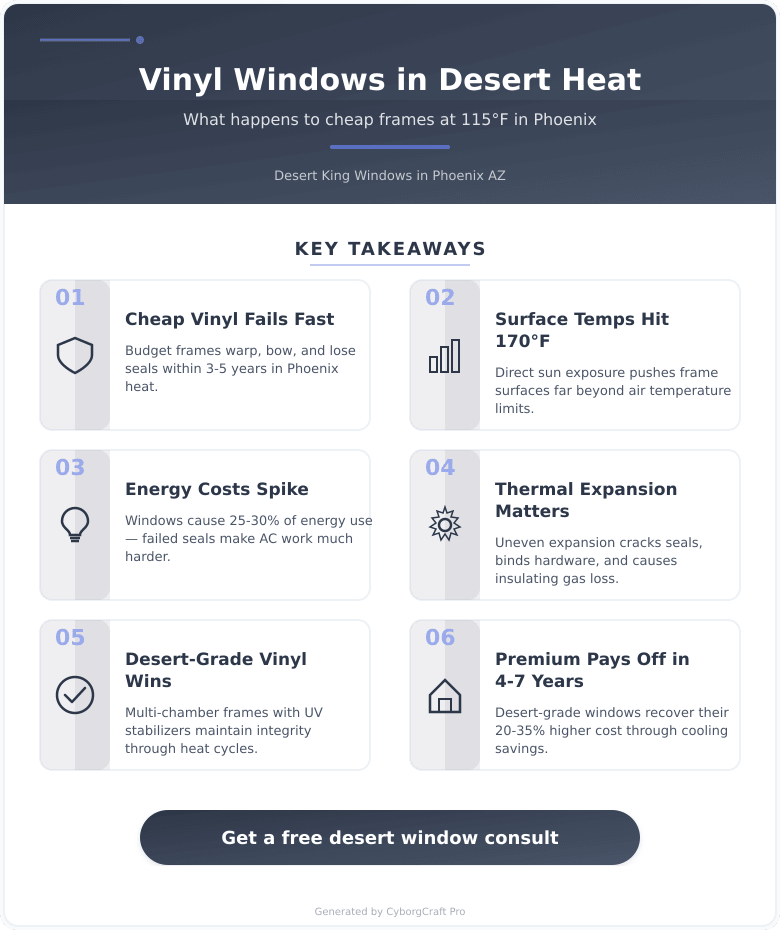
Vinyl Windows in 115-Degree Heat – What Happens to Cheap Frames and What to Look for Instead in the Valley
Vinyl windows in extreme heat are frames made from polyvinyl chloride (PVC) designed to insulate and seal your home, but not all vinyl performs equally under sustained triple-digit temperatures. In Phoenix and across the Valley, the difference between quality vinyl and cheap vinyl shows up fast – and the costs hit your energy bill before you ever notice the damage.
This guide focuses specifically on homeowners in the Phoenix metro area who want to understand what actually happens to vinyl window frames in extreme summer heat – and how to identify products built to last in the desert.
According to the U.S. Department of Energy, windows account for 25-30% of residential heating and cooling energy use. In a climate where your air conditioner runs for six solid months, that number matters more here than almost anywhere else in the country.
What Cheap Vinyl Frames Actually Do in 115-Degree Heat
Here’s the thing most window salespeople skip over: not all vinyl is the same compound. Budget frames use lower-grade PVC with fewer stabilizers and UV inhibitors. When Phoenix summer temperatures push past 110 degrees – and surfaces exposed to direct sun can reach 170 degrees or more – those cheap frames start to show serious problems.
- Warping and bowing along the frame edges, which breaks the seal between the glass and frame
- Color fading and chalking on sun-facing elevations, usually within 3-5 years
- Compression failure in weatherstripping, letting conditioned air escape around the sash
- Hardware binding because the frame expands unevenly and the sash no longer slides or locks correctly
- Condensation between panes when the insulating gas seal fails from repeated thermal expansion and contraction
The most common mistake homeowners make is assuming all vinyl windows carry the same durability. They don’t. A frame rated for mild Midwest summers behaves very differently after a Phoenix July.
Thermal expansion coefficient: The rate at which a material expands per degree of temperature increase – a critical spec for desert window performance that most big-box store displays never mention.
Thinking about replacing windows before the 2025 summer peak hits? Contact us and we’ll walk you through what to look for – no pressure, just straight answers.
Cheap Vinyl vs. Desert-Grade Vinyl Windows: A Direct Comparison
Where budget vinyl succeeds: Low upfront cost, widely available, adequate performance in mild climates with moderate sun exposure.
Where budget vinyl fails: Breaks down under sustained UV and heat load, loses dimensional stability, and may require earlier replacement in Phoenix conditions than homeowners expect.
Where desert-grade vinyl succeeds: Reinforced multi-chamber frames resist warping, titanium dioxide and UV stabilizers slow degradation, tighter tolerances maintain seal integrity through hundreds of heat cycles annually.
Where desert-grade vinyl fails: Higher initial cost – typically 20-35% more per window – and fewer budget retail options carry genuine desert-rated products.
The verdict: In Phoenix, the premium pays for itself. Homeowners who install budget vinyl often replace windows within a decade. Desert-grade vinyl with proper Low-E coatings and gas fills routinely outperforms cheap alternatives on energy savings alone, frequently recovering the price difference within 4-7 years through reduced cooling costs.
| Brand / Line | Frame Type | Price Range Per Window (2025) | Desert Rating | Best For |
|---|---|---|---|---|
| Anlin Windows (Coronado Series) | Multi-chamber vinyl | Contact for current installed pricing | Designed for Southwest heat | Phoenix metro, high sun exposure |
| Milgard (Tuscany Series) | Reinforced vinyl | Contact for current installed pricing | Strong UV resistance | Mid-range desert performance |
| Simonton (StormBreaker Plus) | Fusion-welded vinyl | Contact for current installed pricing | Good thermal stability | Budget-conscious desert upgrade |
| Andersen (100 Series Fibrex) | Composite (wood/PVC) | Contact for current installed pricing | Excellent stability, limited expansion | Premium aesthetics + performance |
| Big-box store generic vinyl | Standard PVC | typically $300-$500 installed | Not rated for sustained extreme heat | Mild climates only |
See how our window selection stacks up for your home – visit our services page for a full overview of what we carry and install.
What to Actually Look for When Buying Vinyl Windows in the Valley
Solar Heat Gain Coefficient (SHGC): A number between 0 and 1 measuring how much solar heat passes through the glass – lower is better for Phoenix homes, with 0.25 or below recommended for south and west-facing windows.
U-Factor: Measures insulation – how fast heat moves through the whole window assembly. Look for 0.30 or below for desert climates, per ENERGY STAR program guidelines.
Beyond the glass specs, here’s what the frame itself needs in a Phoenix home:
- Multi-chamber frame construction (3 or more chambers), which reduces heat transfer through the frame itself
- Fusion-welded corners rather than mechanically fastened, which hold tighter over thousands of heat cycles
- UV stabilizers built into the PVC compound – ask for the specific additive spec, not just a marketing claim
- ENERGY STAR certification for the Southern climate zone (not just any ENERGY STAR label)
- Argon or krypton gas fill between panes with a warm-edge spacer system
Your Vinyl Window Replacement Action Plan
- Step 1 – Inspect your current frames: Look for warping, visible gaps at corners, fogging between panes, or sashes that stick or won’t latch. These are signs your frames have already lost structural integrity.
- Step 2 – Check your SHGC and U-factor: Find the NFRC label on your current windows. If SHGC is above 0.30 on south or west elevations, you’re absorbing significant heat load every summer day.
- Step 3 – Request desert-specific product specs: Ask any window company for the actual PVC compound specifications and UV stabilizer data – not just a brochure. If they can’t provide it, that tells you something.
- Step 4 – Verify ENERGY STAR Southern zone rating: The Southern climate zone has stricter solar requirements. Confirm the product is rated for this zone, not just a general national label.
- Step 5 – Get permits and proper installation: Maricopa County requires permits for full window replacement. Improper installation voids most manufacturer warranties and can create air and water infiltration points.
- Step 6 – Check available rebates: APS and SRP both offer energy efficiency rebates in 2025. Federal tax credits under the Inflation Reduction Act allow up to $600 for qualifying window replacements (2025 limits) – confirm current eligibility with your tax advisor.
Permits, Paperwork, and What to Prepare
- ☐ Maricopa County building permit application (required for full-frame replacements)
- ☐ NFRC product data sheet showing SHGC and U-factor for your chosen window
- ☐ ENERGY STAR Southern zone certification documentation
- ☐ Contractor license verification through the Arizona Registrar of Contractors (azroc.gov)
- ☐ Proof of contractor liability insurance and bonding
- ☐ APS or SRP rebate application (submit before installation in some programs)
- ☐ Federal tax credit documentation (IRS Form 5695 for residential energy credits)
Key Takeaways for Phoenix Homeowners in 2025
- Not all vinyl is equal – cheap frames warp, fade, and fail seal integrity in sustained desert heat
- SHGC below 0.25 matters more here than almost anywhere else in the U.S. for south and west exposures
- Multi-chamber, fusion-welded frames with UV stabilizers outperform budget vinyl by years in Phoenix conditions
- Federal tax credits up to $600 (2025) and utility rebates make quality windows more affordable than many homeowners realize
- Permits and licensed installation protect your warranty and your home’s resale value
Frequently Asked Questions
How long do vinyl windows last in Phoenix heat?
Quality vinyl windows rated for desert climates typically last 20-25 years in Phoenix, while budget vinyl often needs replacement considerably sooner. The difference comes down to UV stabilizers in the PVC compound and multi-chamber frame construction that resists thermal expansion.
What SHGC rating do I need for Phoenix windows?
For Phoenix homes, look for an SHGC of 0.25 or below on south and west-facing windows, and a U-factor of 0.30 or below. ENERGY STAR’s Southern climate zone requirements reflect these thresholds, and windows meeting this spec can noticeably reduce summer cooling loads.
Do I need a permit to replace windows in Maricopa County?
Yes – full-frame window replacements in Maricopa County require a building permit. Insert-style replacements that fit into the existing frame may qualify for a simpler process, but confirm requirements with the county before starting any project.
Are there rebates available for window replacement in Phoenix in 2025?
Yes – both APS and SRP offer energy efficiency rebates for qualifying window replacements, and federal tax credits allow up to $600 for ENERGY STAR-certified windows under current 2025 rules. Check current program availability directly with your utility before purchasing.
How do I verify a window contractor is licensed in Arizona?
Check the Arizona Registrar of Contractors (azroc.gov) to verify any contractor’s license status, bond, and complaint history before signing anything. A legitimate contractor will provide their ROC number without hesitation.
What are signs my vinyl windows are failing from heat damage?
Key warning signs include fogging or condensation between glass panes, visible warping or bowing in the frame, sashes that won’t latch or slide correctly, and rising energy bills without another clear cause. Any of these indicate compromised seal or frame integrity.
What This Means for Your Home This Summer
The Valley doesn’t give cheap materials a pass. At Desert King Windows in Phoenix AZ, located at 2615 S 21st St, Phoenix, AZ 85034, we work with homeowners across Phoenix, Scottsdale, Tempe, Mesa, Chandler, Gilbert, Glendale, and surrounding communities who’ve seen exactly what a hot summer does to windows that weren’t built for this climate.
Recent data shows that homeowners who upgrade to properly rated vinyl with Low-E glass and argon fill often see cooling cost reductions of 15-25% in their first full summer. That’s not a small number when your AC runs from April through October.
If you’re seeing any of the warning signs above, or if your current windows are more than 10 years old, 2025 is the right time to get ahead of the next heat season – not react to it mid-July.
Ready to find out exactly what your home needs? Contact us today for straight answers and a no-obligation assessment. We’ll tell you what we see, what your options are, and what the realistic costs and savings look like – before you commit to anything.
Recent posts
 Vinyl vs. Fiberglass Windows in Arizona: An Honest Desert ComparisonSeptember 28, 2026
 Why Vinyl Windows Are the Smart, Low-Maintenance Choice for Las Vegas HomesSeptember 25, 2026
 Entry-Door Replacement in Phoenix: Curb Appeal That Can Take 115 DegreesSeptember 21, 2026
 The Federal Window Tax Credit Ended – How Las Vegas Homeowners Can Still Save in 2026September 18, 2026