

How to Tell If Your Windows Are Failing – 7 Signs San Antonio Homeowners Miss Until It’s Too Late
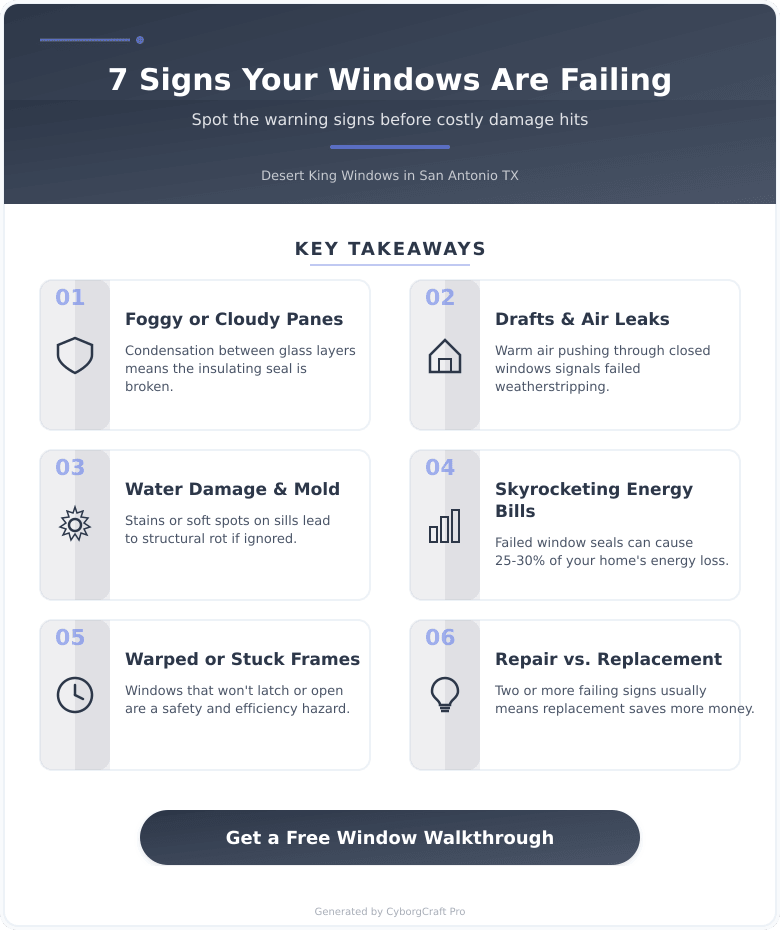
Failing windows are windows that have lost their structural integrity, seal performance, or thermal resistance to the point where they allow air, moisture, or heat to pass through unchecked. Catching the problem early saves homeowners thousands in energy bills, water damage repairs, and emergency replacements.
This guide focuses specifically on the seven warning signs that homeowners in the San Antonio area most commonly overlook until window failure becomes a costly, unavoidable problem.
Window Failure Defined: A failed window is any window unit that no longer performs its core functions – insulating against heat transfer, sealing against air and moisture infiltration, and providing structural security for your home.
The pattern we see most often is this: a homeowner notices one small issue, dismisses it as minor, and then six months later they’re dealing with warped frames, mold around the sill, or an energy bill that jumped $80 overnight. The South Texas heat is unforgiving on window systems, and the signs of trouble tend to pile up quietly before everything goes wrong at once. According to the U.S. Department of Energy, drafty or poorly sealed windows can account for 25-30% of a home’s heating and cooling energy use.
The 7 Signs Your Windows Are Already Failing
- Fogging or condensation between panes: If you see moisture or a cloudy haze trapped between the glass layers, the insulating seal has broken. No amount of cleaning fixes this – the unit needs replacement.
- Drafts when windows are fully closed: Run your hand around the frame on a hot day. Any warm air pushing through means the weatherstripping or frame seal has failed.
- Visible daylight around the frame: Even a hairline gap lets in air and moisture. This one is easy to miss because people assume it’s normal settling.
- Windows that stick, won’t latch, or won’t stay open: Frame warping from heat cycling or moisture intrusion causes this. It’s also a safety concern if emergency egress is blocked.
- Water stains or soft spots on sills and surrounding drywall: Water is getting in somewhere. Ignoring this leads to mold and structural rot faster than most homeowners expect.
- Noticeably higher cooling bills with no other explanation: Compromised window seals in hot climates can contribute to rising cooling costs in ways homeowners may not immediately connect to their windows.
- Outside noise louder than it used to be: A well-sealed double or triple-pane window significantly reduces sound transmission. If you’re hearing more street noise than before, the seal or glazing has degraded.
Thinking about what you just read and wondering if your windows check any of these boxes? Contact us for a no-pressure walkthrough. We’ll tell you honestly what’s failing and what still has life left in it.
Repair vs. Replacement: Which Approach Works?
Where repair succeeds: Minor weatherstripping replacement, hardware adjustments, and exterior caulking can extend window life by 3-5 years if the frame and glass unit are still structurally sound.
Where repair fails: Once the insulating seal between panes is gone, or the frame has warped from moisture, repair is temporary at best. You’re paying to delay the inevitable.
Where full replacement succeeds: New windows with current efficiency ratings (U-factor of 0.30 or lower is the target for Texas climates) immediately reduce heat gain and lower cooling loads. A quality installation also eliminates air infiltration points that patching can’t fully address.
Where full replacement falls short: Cost is the real obstacle. Replacement involves upfront investment, and some older homes require additional framing work that adds to the timeline.
The verdict: If two or more of the seven signs above apply to the same window, replacement is almost always the better financial decision. Repair costs on a failing unit typically run $150-$400 per window, while those same windows continue losing you money on energy every month.
| Option | Cost Range (2025) | Timeline | Best For |
|---|---|---|---|
| Weatherstrip/Caulk Repair | $50-$200 per window | 1 day | Frames in good shape, minor gaps |
| Glass Unit Replacement | $150-$400 per window | 2-5 days | Failed seal, frame still intact |
| Full Window Replacement | $300-$800 per window | 1-3 days install | Warped frames, multiple failure signs |
Leading Window Brands Worth Knowing
| Brand | Product Line | Price Range (2025) | Warranty | Best For |
|---|---|---|---|---|
| Andersen | 400 Series | $400-$800/window | 20-year | Classic look, wood interiors |
| Pella | Impervia Fiberglass | $350-$750/window | Limited lifetime | High-heat durability |
| Simonton | StormBreaker Plus | $250-$550/window | Limited lifetime | Wind and impact resistance |
| Milgard | Tuscany Vinyl | $300-$650/window | Full lifetime | Budget-conscious replacement |
| PGT Innovations | WinGuard Vinyl | $350-$700/window | Limited lifetime | Storm and impact protection |
Your Window Assessment Action Plan
- Step 1 – Visual inspection: Walk every window in your home and check for condensation between panes, visible gaps, and water staining. Mark any that show problems.
- Step 2 – The hand test: On a hot afternoon, hold your palm near the frame and glass of each flagged window. Heat radiating through the glass or air movement around the frame confirms failure.
- Step 3 – Check operation: Open and close every window. Sticking, loose latches, or frames that won’t hold position are mechanical failure flags.
- Step 4 – Review your energy bill trend: Pull the last 12 months of bills. A steady upward trend in summer cooling costs with no other obvious cause points directly to window performance loss.
- Step 5 – Get a professional assessment: Once you’ve identified suspect windows, get eyes on them from someone who can distinguish a repairable issue from a unit that needs full replacement.
Tax Credits and Rebate Programs (2025)
The federal Energy Efficient Home Improvement Credit covers 30% of the cost of qualifying replacement windows, up to $600 per year (2025 limits), under IRS Section 25C. Windows must meet ENERGY STAR Most Efficient criteria. Texas does not currently offer a state-level window rebate, but CPS Energy in San Antonio has offered rebate programs for qualifying efficiency upgrades – check current availability directly with CPS Energy, as program terms change annually.
U-factor definition: A measure of how well a window prevents heat transfer, where lower numbers mean better insulating performance. For Texas climates, target 0.30 or below.
SHGC definition: Solar Heat Gain Coefficient measures how much solar radiation passes through the glass. In South Texas heat, aim for 0.25 or lower to reduce cooling loads.
What This Means for Homeowners Near 1890 S Brazos St
The most common mistake we see is homeowners waiting until a window is completely broken before calling anyone. By that point, the water damage to surrounding drywall or the mold starting behind the trim has already added to the repair scope. San Antonio’s summer heat cycles push window systems hard – intense UV, high temperatures, and periodic heavy rain create stress patterns that accelerate seal failure on windows that were installed more than 10-12 years ago.
At Desert King Windows in San Antonio TX, we work with homeowners throughout the area, including Alamo Heights, Helotes, Converse, Leon Valley, and surrounding neighborhoods. Our approach starts with an honest assessment – not every window needs replacing, and we’ll tell you that straight.
Ready to stop guessing? Contact us today and we’ll walk through your home, identify what’s actually failing, and give you a clear picture of your options – no obligation.
Key Takeaways for San Antonio Homeowners in 2025
- Fogged panes mean the seal is gone – no repair restores a broken insulating unit
- Drafts and daylight gaps directly inflate your cooling bill every single day
- Water stains around frames signal moisture intrusion that worsens fast in humid conditions
- Federal tax credits cover 30% of qualifying replacements up to $600 in 2025
- Windows older than 10-12 years in South Texas climates deserve a close inspection this year
Frequently Asked Questions
How do I know if my window seal is broken?
A broken window seal shows up as persistent fogging, condensation, or a cloudy haze trapped between the glass panes that cannot be wiped away. This happens when the inert gas insulation (argon or krypton) escapes through a failed perimeter seal, allowing moisture-laden air to enter the space between panes.
How much does window replacement cost in the San Antonio area in 2025?
Full window replacement in the San Antonio area typically runs $300-$800 per window for standard sizes, including installation labor. Total project cost depends on window count, frame material, glass specifications, and whether any surrounding trim or framing needs repair.
Do I need a permit to replace windows in San Antonio?
Most like-for-like window replacements in San Antonio do not require a permit, but adding new window openings or changing rough opening sizes does. Your contractor should confirm permit requirements with the City of San Antonio Development Services Department before work begins.
How long does window replacement take?
A standard single-day installation can cover 8-12 windows for most residential projects. Custom sizes, specialty glass orders, or structural framing repairs extend the timeline, sometimes by 2-4 weeks for the manufacturing lead time alone.
Can I replace just the glass without replacing the whole window?
Yes, if the frame is structurally sound and not warped, replacing just the insulated glass unit (IGU) is an option that costs less than full replacement. However, if the frame itself has deteriorated or the window is more than 15 years old, full replacement is usually the better long-term investment.
What window efficiency rating should I look for in Texas?
For South Texas climates, target a U-factor of 0.30 or below and a Solar Heat Gain Coefficient (SHGC) of 0.25 or lower. The ENERGY STAR program provides region-specific ratings that account for Texas heat loads and can guide your product selection.
Are failing windows covered by homeowners insurance?
Standard homeowners insurance typically does not cover window replacement due to age, wear, or gradual seal failure. Sudden damage from storms, hail, or vandalism may be covered depending on your policy – check with your insurer before assuming coverage applies.
Recent posts
 Vinyl vs. Fiberglass Windows in Arizona: An Honest Desert ComparisonSeptember 28, 2026
 Why Vinyl Windows Are the Smart, Low-Maintenance Choice for Las Vegas HomesSeptember 25, 2026
 Entry-Door Replacement in Phoenix: Curb Appeal That Can Take 115 DegreesSeptember 21, 2026
 The Federal Window Tax Credit Ended – How Las Vegas Homeowners Can Still Save in 2026September 18, 2026