
This guide focuses specifically on why Phoenix-area homeowners who buy windows from big box retailers frequently face problems that could have been avoided with a local, desert-focused window provider.
Big Box Store Windows Definition: Windows sold through national home improvement chains (Home Depot, Lowe’s, Menards) that are stocked for a national audience, not engineered for the extreme heat, UV exposure, and monsoon conditions specific to the Phoenix metro area.
What Big Box Store Windows Actually Get Wrong in Phoenix
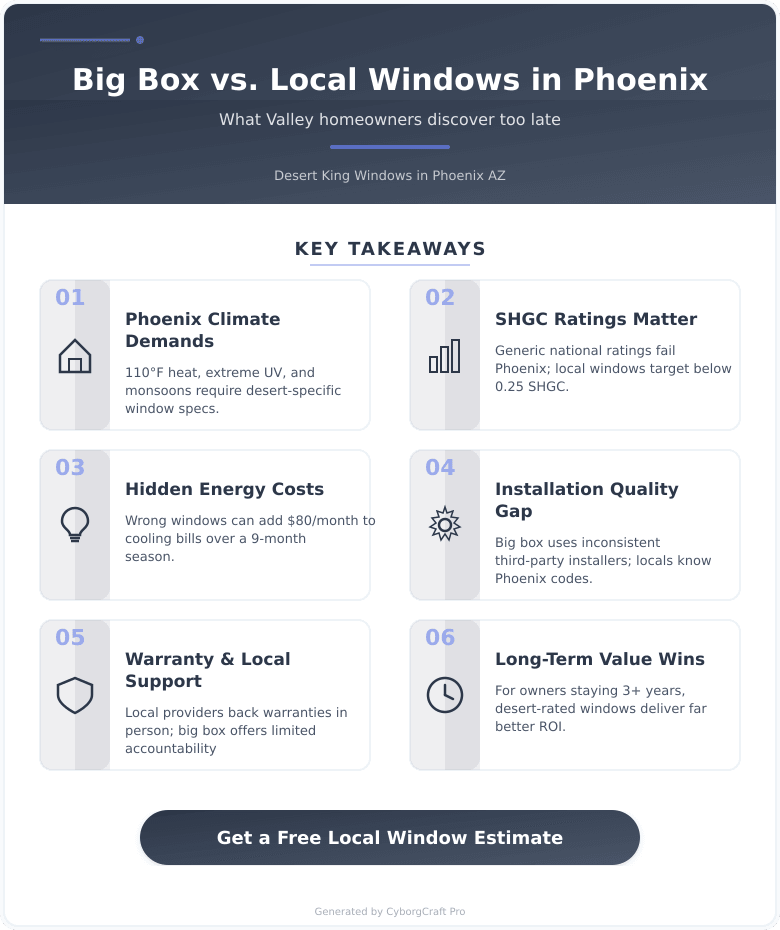
Phoenix is not a normal climate. The Valley sees summer temperatures above 110 degrees for weeks at a time, UV index levels that destroy inferior materials in two to three seasons, and monsoons that send water sideways through any gap in a window frame. Big box windows are designed to sell across 50 states. That means the specs are averaged across climates, not optimized for yours.
According to the U.S. Department of Energy, windows account for 25 to 30 percent of residential heating and cooling energy use. In Phoenix, where cooling runs nine months a year, that number hits harder than almost anywhere else in the country. A window with a Solar Heat Gain Coefficient (SHGC) built for Seattle or Chicago is a liability in Scottsdale or Tempe.
The most common mistake homeowners make is comparing window prices without comparing window performance specs. A big box window may cost $180 installed. But if it adds $80 per month to your cooling bill, it costs far more over five years than a desert-rated window from a local provider.
Thinking about this for your situation? Let’s talk. Contact us and we’ll walk you through your options – no pressure.
Big Box Windows vs. Local Desert-Rated Windows: Which Approach Works?
Where big box windows succeed: Lower upfront sticker price, immediate availability, familiar brand recognition, and easy initial comparison shopping.
Where big box windows fail: Generic SHGC and U-factor ratings not calibrated for Phoenix heat, installation handled by third-party subcontractors with inconsistent quality, limited local warranty support, and no accountability once the job is done.
Where local desert-rated windows succeed: Products selected specifically for Arizona climate performance, licensed local installers who understand Phoenix-specific building codes, manufacturer warranties backed by a local business, and ongoing support if something goes wrong.
Where local desert-rated windows can fail: Higher upfront cost, longer lead times on some product lines, and fewer walk-in showroom options for impulse shoppers.
The verdict: For Phoenix homeowners planning to stay in their homes longer than three years, local desert-rated windows deliver substantially better long-term value. The price gap at purchase narrows quickly once energy savings and avoided repair costs are factored in.
| Option | Upfront Cost (Per Window, 2025) | SHGC Rating | Local Warranty Support | Best For |
|---|---|---|---|---|
| Big Box Standard | Varies by product and market | Generic (varies) | No | Rental properties, short-term flips |
| Big Box Premium | $350 – $600 | Moderate (0.22-0.30) | Limited | Budget-conscious buyers |
| Local Desert-Rated | Varies by provider and product | Desert-optimized (below 0.25) | Yes | Owner-occupied Phoenix homes |
| Custom Local Install | $700 – $1,400 | High performance (below 0.20) | Full local support | High-value homes, long-term owners |
The Installation Problem Nobody Talks About
Here’s what catches a lot of Valley homeowners off guard. Big box stores don’t actually install windows themselves. They contract the work out to third-party installers – often whoever is available in the area that week. Quality varies wildly. If the install is sloppy, you get air leaks, water intrusion during monsoon, and frame gaps that drive up your cooling costs immediately.
A poor install can void the window manufacturer’s warranty. So you paid for a product that has no warranty coverage because the person who installed it wasn’t the manufacturer’s certified installer. That’s a frustrating situation to be in.
Local window companies like Desert King Windows in Phoenix AZ maintain professional installation standards, which means consistent work and clear accountability if anything needs to be addressed later.
Arizona Tax Credits and Rebates Worth Knowing in 2025
Federal Section 25C tax credit offers 30% of costs up to $600 annual aggregate cap for qualifying windows and other envelope improvements. Windows must meet Energy Star Most Efficient criteria to qualify – and many big box window products do not clear that bar for a desert climate.
Arizona Public Service (APS) and Salt River Project (SRP) both offer rebate programs for qualifying energy-efficient upgrades. Check current program availability directly with your utility, as rebate amounts and eligibility requirements update regularly. A local window company familiar with Phoenix utility programs can help you identify what applies to your home.
Your Window Replacement Action Plan
- Step 1 – Check Performance Specs First: Look for SHGC below 0.25 and U-factor below 0.30 for Phoenix conditions. These numbers matter more than brand names.
- Step 2 – Verify Installer Credentials: Confirm the Arizona Registrar of Contractors license number for any company doing the install. Arizona law requires it.
- Step 3 – Ask About Warranty Coverage: Get clarity on what’s covered, for how long, and who you call locally if something goes wrong.
- Step 4 – Confirm Energy Star Eligibility: If you plan to claim the federal tax credit, verify the specific product qualifies before purchase.
- Step 5 – Get Multiple Quotes: Compare local providers alongside big box options. The total cost of ownership – not just the sticker price – is what matters.
What to Check Before Signing Anything
- SHGC and U-factor specs for desert climate performance
- Arizona ROC license number for the installing contractor
- Written warranty terms for both product and installation
- Energy Star Most Efficient certification for tax credit eligibility
- Local point of contact for post-install service
- Timeline and process for monsoon-season installs
Key Takeaways for Phoenix Homeowners in 2025
- Performance specs matter more than price – a cheap window in Phoenix heat costs more long-term
- Big box installation quality is inconsistent – third-party crews aren’t always accountable to anyone
- Local warranty support is a real differentiator – national retailers can’t send someone to your Chandler or Glendale home quickly
- Federal tax credits are available in 2025 – but only for products that meet Energy Star Most Efficient criteria
- Desert King Windows serves the Phoenix metro area – including Scottsdale, Tempe, Mesa, Chandler, and Glendale
Frequently Asked Questions
Are big box store windows actually lower quality than what a local window company sells?
Not always in terms of raw materials, but often in terms of desert suitability and installation consistency. The bigger issue is that big box windows are selected for a national market, not for Phoenix conditions specifically – and the install quality depends entirely on whoever the store subcontracted that week.
How much can I save on energy costs by upgrading to desert-rated windows in Phoenix?
Most Phoenix homeowners report cooling cost reductions of 15 to 30 percent after upgrading to high-performance low-SHGC windows. Exact savings depend on your home’s size, existing window condition, and current utility rates – but the Department of Energy confirms windows are one of the highest-impact upgrades for energy efficiency.
Do I need a permit to replace windows in Phoenix AZ?
In most cases, like-for-like window replacements in Phoenix do not require a permit, but structural changes or new window openings do. Always confirm with the City of Phoenix Development Services or your local municipality before work begins, especially in 2025 when code updates may apply.
What SHGC rating do I need for windows in Phoenix?
For Phoenix-area homes, look for an SHGC at or below 0.25 to meaningfully reduce solar heat gain. The lower the number, the less heat the window allows into your home – which is critical when outdoor temps exceed 110 degrees for extended periods each summer.
How long does a window replacement project take in the Phoenix area?
Most standard window replacement projects in Phoenix take one to two days for the installation itself, with lead times of two to six weeks for product ordering depending on the brand and configuration. Custom sizes or specialty glass can extend that timeline.
How do I verify a window contractor is licensed in Arizona?
Use the Arizona Registrar of Contractors online license lookup at azroc.gov to verify any contractor’s license number, status, and complaint history before signing a contract. This takes about two minutes and can save significant headaches.
Ready to Make a Smarter Choice for Your Phoenix Home?
Big box windows aren’t the right call for most Valley homeowners planning to stay in their home long-term. The pricing looks good at first glance, but the performance gaps, inconsistent installs, and lack of local support add up fast in a climate as demanding as Phoenix.
If you’re in Phoenix, Scottsdale, Tempe, Mesa, Chandler, Glendale, or anywhere across the Valley, getting windows that are actually built and installed for desert conditions makes a real difference – on your energy bills and on your peace of mind.
Ready to take the next step? Contact us today for straight answers and real solutions. Or explore our window services to see what we offer Valley homeowners.