

Front Door Replacement in Scottsdale and Chandler – Why Your Current Door May Be Your Home’s Biggest Security and Energy Weak Point
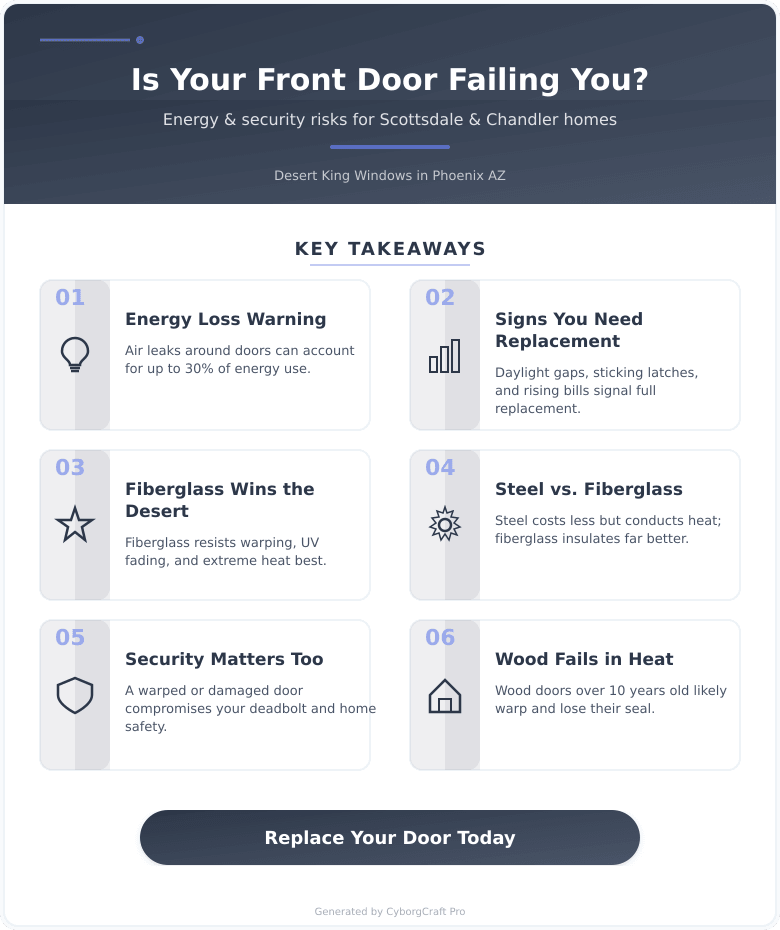
Front door replacement in Scottsdale and Chandler is the process of removing an aging or underperforming entry door and installing a new unit rated for extreme heat, high-UV exposure, and modern security standards. In the Phoenix metro area, where summer temperatures regularly push past 110 degrees, a failing door costs homeowners in both comfort and monthly energy bills.
This guide focuses specifically on front door replacement for Scottsdale and Chandler homeowners who want to reduce energy loss, strengthen home security, and choose the right door material for desert conditions.
Here’s something most people don’t think about: the front door is one of the largest single gaps in a home’s thermal envelope. Gaps around the frame, an aged sweep, or a warped slab can push your HVAC system to work harder every single day. According to the U.S. Department of Energy, air leaks around doors and windows account for up to 30% of a home’s heating and cooling energy use. In Scottsdale and Chandler, that number hits harder because your AC never really gets a break.
The most common mistake we see is homeowners patching weatherstripping on a door that has already warped or lost its structural integrity. That’s putting a bandage on the wrong problem. A full front door replacement solves it from the ground up.
Signs Your Front Door Needs Replacing, Not Patching
Repair works when the damage is minor. Replacement makes more sense when you notice any of these:
- Daylight is visible around the door frame when it’s closed
- The door sticks, drags, or no longer latches cleanly
- You feel hot air pushing through the frame during summer
- The door material is visibly warped, cracked, or faded
- Your lock or deadbolt feels loose or shows signs of forced entry
- Energy bills are climbing with no other obvious cause
Wood doors especially struggle in the Phoenix metro. UV exposure and heat cycles cause expansion and contraction that eventually splits joints and compromises the seal. If your door is wood and over 10-12 years old, there’s a good chance it’s working against you.
Front Door Replacement: Material Comparison for Scottsdale and Chandler Homes
Material choice drives most of the performance difference. Here’s how the four main options stack up in desert conditions:
| Material | Cost Range | Heat Resistance | Security Rating | Best For |
|---|---|---|---|---|
| Steel | Varies by project | Good with insulated core | High | Security-focused buyers |
| Fiberglass | Varies by project | Excellent – won’t warp | High | Desert climate performance |
| Wood | Varies by project | Poor – warps and fades | Medium | Historic or aesthetic-only cases |
| Composite | Varies by project | Very good | Medium-High | Value-focused desert homes |
Fiberglass is the most recommended material for Scottsdale and Chandler front door replacement. It doesn’t absorb heat the same way steel can, it resists UV fading, and it holds its shape through extreme temperature swings. Brands like Therma-Tru and Masonite both offer fiberglass lines built specifically for high-heat climates.
Steel vs. Fiberglass: Which One Actually Wins in the Desert?
Where steel succeeds: Lower upfront cost, excellent forced-entry resistance, and widely available in standard sizes for quick turnaround.
Where steel fails: Steel conducts heat, which means south-facing or west-facing doors in Chandler or Scottsdale can get dangerously hot to the touch and transfer more heat into your home. It can also dent and rust over time, especially near irrigation systems.
Where fiberglass succeeds: True insulating value, no rust, no warping, and it can be textured to look like wood without the maintenance problems. Fiberglass doors with polyurethane foam cores offer U-factors as low as 0.17, which is excellent for energy performance.
Where fiberglass fails: Higher upfront cost and fewer budget-tier options. Some lower-end fiberglass doors use thinner skins that can crack under severe impact.
The verdict: For front door replacement in Scottsdale and Chandler, fiberglass wins for most homeowners. The energy savings and durability over a 10-15 year lifespan more than offset the higher initial price. Steel makes sense when budget is the primary driver and the door doesn’t face direct afternoon sun.
Thinking about this for your situation? Let’s talk. Contact us and we’ll walk you through your options with no pressure.
Your Front Door Replacement Action Plan
- Step 1 – Assess your current door: Check for visible gaps, warping, latch problems, and frame damage. Note which direction the door faces – south and west exposures in Scottsdale take the most UV and heat abuse.
- Step 2 – Choose your material: Fiberglass for performance, steel for budget security. Confirm the door has an Energy Star rating and a foam-filled core for Arizona conditions.
- Step 3 – Measure the rough opening: Standard doors are 80 inches tall and 36 inches wide, but older Scottsdale and Chandler homes sometimes have non-standard openings. Measure before ordering.
- Step 4 – Verify permits: Maricopa County generally requires a building permit for full door and frame replacement. Your installer should pull this permit – if they don’t, that’s a red flag.
- Step 5 – Schedule installation: Spring and fall are ideal in the Phoenix metro. Summer installs work but require early-morning scheduling to avoid working in peak heat.
- Step 6 – Inspect and seal: After installation, check the frame seal, sweep contact, and lock alignment before the installer leaves. These should all be addressed on day one.
Arizona Tax Credits and Rebates Worth Knowing (2025)
Front door replacement can qualify for the federal Energy Efficient Home Improvement Credit under IRS Section 25C, which covers up to 30% of the cost for qualifying exterior doors – capped at $250 per door and $500 total for 2025. Doors must meet Energy Star requirements to qualify. Arizona does not currently offer a separate state-level door rebate, but APS and SRP utility customers should check their program pages for available rebates on Energy Star products, which change periodically.
For a complete overview of our services and what products we carry, visit our services page.
What to Look for in a Contractor
Front door replacement sounds simple, but a poor install wipes out every advantage a good door offers. Ask any contractor you consider these questions:
- Are you licensed with the Arizona Registrar of Contractors (ROC)?
- Do you pull the required permits for Scottsdale or Chandler projects?
- What does your warranty cover – labor, materials, or both?
- Can you show proof of general liability insurance?
At Desert King Windows in Phoenix AZ, serving homeowners throughout the Phoenix metro area including Scottsdale, Chandler, Tempe, Mesa, and Gilbert, we focus on installations that are done right the first time – frame sealed, sweep adjusted, and lock aligned before we ever pack up.
Key Takeaways for Scottsdale and Chandler Homeowners in 2025
- Air leaks matter more than most realize – up to 30% of cooling energy escapes through gaps around doors and windows
- Fiberglass outperforms wood and often steel in Arizona’s heat cycles and UV exposure
- Federal tax credits cover up to 30% of qualifying door costs through the Section 25C program in 2025
- Permits are required for full door and frame replacement in Maricopa County – always verify your contractor pulls them
- South and west-facing doors need the most attention – direct sun exposure accelerates seal failure and material degradation
Frequently Asked Questions
How much does front door replacement cost in Scottsdale or Chandler?
Most front door replacements in the Scottsdale and Chandler area run between $1,200 and $4,000 installed, depending on material and complexity. Fiberglass entry doors sit toward the higher end of that range, while steel doors are typically more affordable. Custom sizes, sidelights, and decorative glass add to the total.
How long does front door replacement take?
Most front door replacements are completed in a single day, typically 2-4 hours for a standard opening. Custom or non-standard openings may require additional framing work and could extend to a full day.
Do I need a permit for front door replacement in Chandler or Scottsdale?
Yes, a building permit is generally required in both Chandler and Scottsdale when replacing the door and frame together. A licensed contractor should handle the permit process. Replacing only the slab in an existing frame may not require a permit, but confirm with your local city office.
What is the best front door material for Arizona heat?
Fiberglass is the top-performing material for front door replacement in Arizona’s climate. It resists warping, UV fading, and heat transfer better than wood or steel, and foam-core fiberglass doors provide strong insulating value.
Can front door replacement lower my energy bills?
Yes – a properly sealed, insulated door can meaningfully reduce air conditioning load by eliminating conditioned air loss around the frame. Homes with older or warped doors often see measurable improvements in comfort and energy use after replacement.
What Energy Star rating should I look for in a replacement door?
Look for doors with a U-factor of 0.20 or lower and an Energy Star certification for the Southern climate zone. Scottsdale and Chandler fall within that zone, and the lower the U-factor, the better the door’s insulating performance in desert heat.
Is it better to repair or replace a front door?
Replace when the frame is damaged, the door is warped, or the seal has failed repeatedly despite repairs. Patch jobs on structurally compromised doors are short-term fixes that don’t address the underlying problem.
Ready to Take the Next Step?
Your front door does more than greet guests. It controls how much cool air stays inside during a 112-degree Scottsdale afternoon and how hard your locks have to work if someone tests them. Both of those things matter, and both degrade quietly until the cost becomes obvious.
The good news is that 2025 is a solid year to act – federal credits are in place, product availability is strong, and getting ahead of summer heat means a comfortable spring install window. Ready to get a straight answer about what your home actually needs? Contact us today and we’ll give you real information, not a sales pitch.
Recent posts
 Vinyl vs. Fiberglass Windows in Arizona: An Honest Desert ComparisonSeptember 28, 2026
 Why Vinyl Windows Are the Smart, Low-Maintenance Choice for Las Vegas HomesSeptember 25, 2026
 Entry-Door Replacement in Phoenix: Curb Appeal That Can Take 115 DegreesSeptember 21, 2026
 The Federal Window Tax Credit Ended – How Las Vegas Homeowners Can Still Save in 2026September 18, 2026