

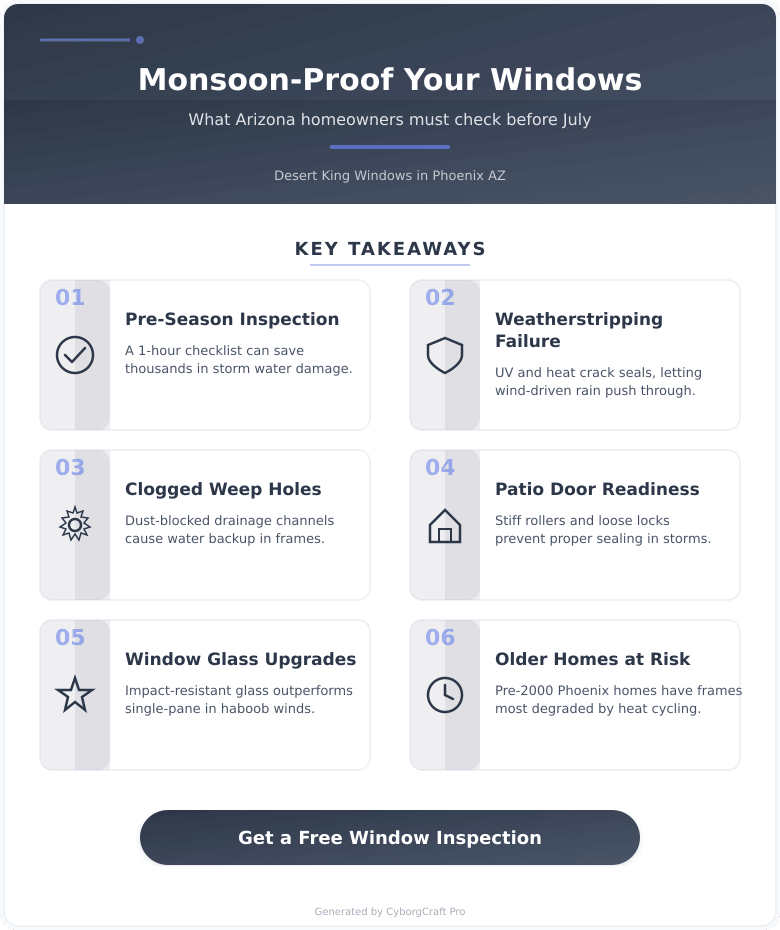
Monsoon Season Is Coming – Are Your Windows and Patio Doors Actually Ready for What Arizona Throws at Them?
Arizona monsoon window readiness is the process of inspecting, sealing, and upgrading windows and patio doors before Arizona’s summer storm season to prevent water intrusion, wind damage, and energy loss. Getting ahead of monsoon prep is one of the most practical things a Phoenix homeowner can do before July rolls around.
This guide focuses specifically on what Phoenix-area homeowners need to check, fix, or replace on their windows and patio doors before monsoon season 2025.
Arizona Monsoon Window Readiness Definition: A pre-season inspection and upgrade process that ensures residential windows and patio doors can withstand Arizona’s haboob winds, driving rain, and sudden pressure changes without failing, leaking, or losing efficiency.
Arizona monsoon season typically runs from June 15 through September 30. Phoenix receives a significant portion of its annual rainfall during the monsoon months, most of it arriving in violent bursts. Winds during haboobs regularly hit 50-60 mph. Your windows and patio doors take that hit directly.
The most common mistake we see is homeowners waiting until after the first major storm to discover a failing seal or a door frame that lets in a sheet of water. By then, the damage is already started.
What Arizona Monsoons Actually Do to Windows and Patio Doors
Most people think about wind. But it’s the combination of pressure changes, blowing dust, and sudden downpours that causes real problems. Here’s what actually happens:
- Aged weatherstripping compresses and cracks under repeated UV exposure, letting water push through
- Weep holes (the small drainage channels in window frames) clog with dust and debris, backing up water
- Patio door tracks collect sediment that prevents proper sealing when the door closes
- Frame expansion from heat followed by rapid cooling during storms stresses old caulk lines
- Single-pane or older double-pane glass sees pressure differentials that can crack seals and fog the glass
Homes in Phoenix, especially those built before 2000, are particularly vulnerable. Frames and seals that were adequate in a drier climate have often been degraded by years of extreme UV and heat cycling.
Arizona Monsoon Window Readiness: Your Pre-Season Inspection Checklist
Run through this before the season hits. It takes about an hour and can save you thousands in water damage repairs.
- ☐ Check all weatherstripping around window frames – press it and see if it springs back or crumbles
- ☐ Inspect exterior caulk lines for cracks, gaps, or separation from the frame
- ☐ Clear weep holes in window sills and door tracks of dust and debris
- ☐ Test patio door rollers – doors that drag or stick won’t seal properly under wind pressure
- ☐ Look for fogging between glass panes – that’s a failed seal already
- ☐ Check that all window locks engage fully – loose locks mean loose compression on the seal
- ☐ Examine the exterior flashing above windows and doors for lifted edges
Thinking about this for your situation? Let’s talk. Contact us and we’ll walk you through your options – no pressure, no obligation.
Single-Pane vs. Double-Pane vs. Impact-Resistant Windows: Which Approach Works?
Where single-pane windows succeed: Lower upfront cost, easy replacement of individual panes, suitable for interior or covered applications.
Where single-pane windows fail: No insulating value, zero sound dampening from storm noise, and essentially no resistance to wind-driven rain or pressure differentials during a haboob.
Where standard double-pane windows succeed: Good thermal performance, improved comfort, and decent weather resistance when seals are intact and frames are sound.
Where standard double-pane windows fail: Seal failures are common after several Phoenix summers, and they’re not rated for high wind-driven rain without proper installation and framing.
The verdict: For Phoenix homes facing monsoon season 2025 and beyond, double-pane windows with low-E coatings and impact-rated patio doors are the practical floor for real protection. Impact-resistant options make sense for any home with significant glass exposure or older framing.
| Window Type | Cost Range (2025) | Wind Rating | Best For |
|---|---|---|---|
| Single-Pane | Contact us for current pricing | Not rated | Interior only, low-exposure areas |
| Standard Double-Pane | Contact us for current pricing | Up to 90 mph (frame dependent) | Most Phoenix homes, good baseline |
| Impact-Resistant Double-Pane | Contact us for current pricing | Up to 150+ mph | High exposure, older homes, patio doors |
| Triple-Pane | $700 – $1,400/window installed | Up to 120 mph | Maximum insulation, noise reduction |
Your Monsoon Window Prep Action Plan
- Step 1 – Inspect now (June or earlier): Complete the checklist above before July. Early action means you have time to order materials or schedule a professional before demand spikes.
- Step 2 – Replace failed weatherstripping: This is a DIY-friendly fix. Hardware stores carry pre-cut foam or rubber strips for standard frame sizes. Expect to spend $20-$60 per window.
- Step 3 – Re-caulk problem areas: Use a silicone-based exterior caulk rated for high heat. Standard latex caulk breaks down fast in Phoenix sun. Cost is minimal; time is about 30 minutes per window.
- Step 4 – Service patio door rollers and tracks: Clean tracks thoroughly, then apply a dry lubricant. If rollers are worn or the door drags significantly, roller replacement typically runs $75-$150 as a service call.
- Step 5 – Evaluate replacement needs: If you found fogged panes, cracked frames, or doors that won’t seal even after cleaning, those aren’t maintenance issues – they’re replacement candidates before storm season hits.
Tax Credits and Rebates for Window Upgrades in Arizona (2025)
The federal ENERGY STAR program qualifies certain window and door replacements for the Energy Efficient Home Improvement Credit. As of 2025, homeowners can claim up to 30% of the cost of qualifying windows and skylights, up to $600 per year, and up to $250 per exterior door (maximum $500 for doors). To qualify, products must meet specific U-factor and solar heat gain coefficient (SHGC) requirements. Arizona’s high solar exposure means many standard products qualify. Ask for documentation from your installer to claim this credit on your 2025 return.
Salt River Project (SRP) and Arizona Public Service (APS) also offer rebates periodically for qualifying energy-efficient upgrades. Check current program availability directly with your utility provider before purchasing.
Common Mistakes That Leave Phoenix Homes Vulnerable
Mistake 1 – Skipping the weep holes: Clogged weep holes are one of the top causes of water intrusion during monsoons. Clean them with a small wire or toothpick before every season.
Mistake 2 – Using interior caulk outside: Paintable interior caulk fails quickly in direct sun. Only use 100% silicone or hybrid silicone caulk on exterior applications.
Mistake 3 – Assuming new construction is fine: Even homes built in 2015-2020 may have weatherstripping that has degraded from Phoenix’s UV intensity. Age isn’t the only factor.
Mistake 4 – Ignoring patio door alignment: A sliding patio door that’s slightly off-track won’t compress its seal evenly. That gap is exactly where monsoon water finds its way in.
Key Takeaways for Phoenix Homeowners in 2025
- Monsoon season starts June 15 – pre-season prep should happen in May or early June at the latest
- Weep holes and weatherstripping are the two most overlooked failure points on Phoenix windows
- Impact-rated patio doors offer meaningful upgrades for homes with large glass exposure facing south or west
- Federal tax credits in 2025 cover up to 30% of qualifying window replacement costs
- DIY maintenance works for sealing and cleaning, but fogged glass and damaged frames need professional replacement
At Desert King Windows in Phoenix AZ, we serve homeowners throughout Maricopa County including Tempe, Chandler, Mesa, Scottsdale, Glendale, Peoria, and the surrounding communities. Our team handles everything from pre-season assessments to full window and patio door replacement before the storms hit.
Frequently Asked Questions
How do I know if my patio door seal is failing before monsoon season?
A failing patio door seal typically shows visible gaps in the weatherstripping, a door that doesn’t close flush, or visible daylight around the frame when closed. Run a flashlight along the interior frame edge at night – light bleeding through indicates gaps that will let in water during a storm.
Do I need a permit to replace windows in Phoenix, AZ?
In most cases, like-for-like window replacements in Phoenix do not require a permit, but adding new window openings or changing frame sizes does. Check with the City of Phoenix Development Services before any structural modifications. Your installer should handle permit coordination for larger projects.
How much does window replacement cost in Phoenix in 2025?
Window replacement in Phoenix generally runs $300 to $1,200 per window installed, depending on size, glass type, and frame material. Patio door replacements typically cost $1,500 to $4,000 for standard sliding units. Impact-rated options run higher but qualify for federal tax credits.
What is a U-factor and does it matter in Arizona?
U-factor measures how quickly a window transfers heat – lower numbers mean better insulation. For Arizona, a low Solar Heat Gain Coefficient (SHGC) matters more than U-factor alone, since blocking solar radiation is the priority. Look for an SHGC of 0.25 or lower for west and south-facing windows.
Can I DIY weatherstripping and caulking before monsoon season?
Yes – weatherstripping replacement and exterior re-caulking are genuinely manageable DIY projects for most homeowners. Use 100% silicone caulk rated for high-heat applications and follow manufacturer instructions for surface prep. If the frame itself is damaged or rotting, that’s a job for a professional.
What wind speed should Phoenix windows be rated for?
Phoenix building codes generally require windows rated for a minimum design wind pressure corresponding to local code requirements, typically equivalent to sustained winds around 90 mph for residential applications. Haboobs can push gusts higher in localized areas, so impact-rated glass rated for 130+ mph is worth considering for exposed elevations.
Ready Before the First Storm Hits
Monsoon prep isn’t a September conversation – it’s a June one. The homes that come through storm season without water damage are the ones where someone ran the checklist, replaced the worn weatherstripping, and called for an assessment before the haboob season started.
Ready to take the next step? Contact us today for straight answers and a real assessment of what your windows and patio doors need before monsoon 2025. We’ll tell you exactly what we find and what it would cost to fix – no guesswork, no pressure. Or visit our services page to see the full range of window and door solutions we offer to Phoenix-area homeowners.
Recent posts
 The Federal Window Tax Credit Just Expired – Las Vegas Homeowners Who Replaced Their Windows in 2025 Can Still Claim Up to $600 on This Year’s ReturnJune 9, 2026
 Front Door Replacement in San Antonio – How Much Heat, Light, and Security You’re Losing Through Your Current DoorJune 6, 2026
 The Problem With Buying Windows From a Big Box Store in the Phoenix Area – What Valley Homeowners Find Out Too LateJune 4, 2026
 Why Your NV Energy Bill Is Still Over $350 a Month – And How the Right Las Vegas Windows Can Cut It by 30% Before This SummerJune 2, 2026