

How to Choose the Right Front Door for a Las Vegas Home in 2026 – Beating the Heat, Beating the Sun, and Still Having the Best Curb Appeal on the Street
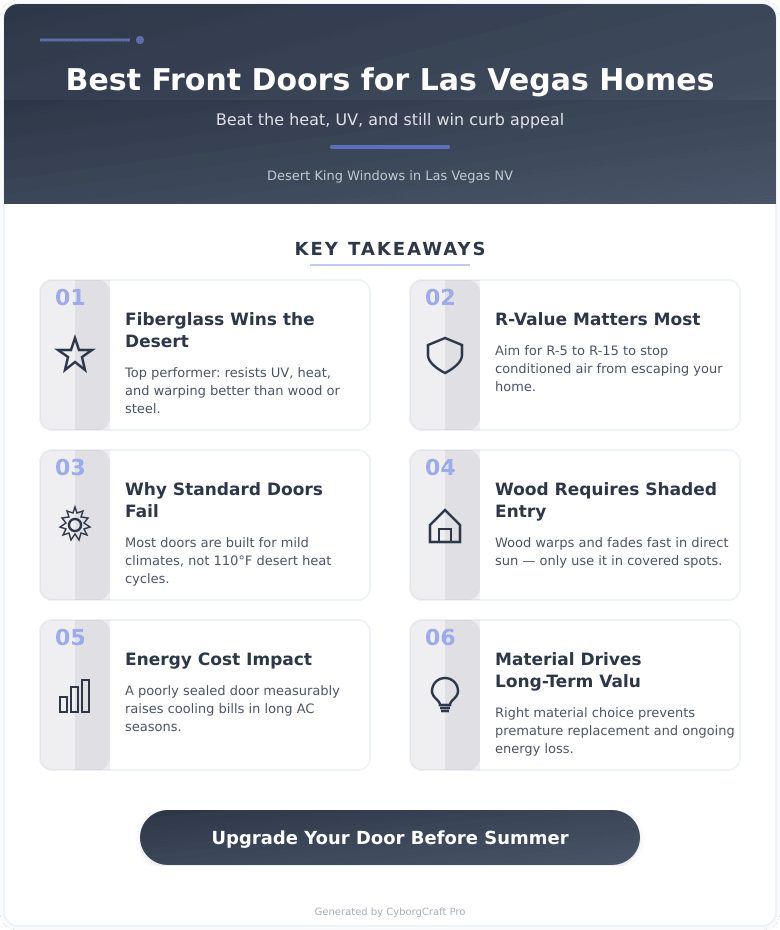
Choosing the right front door for a Las Vegas home means selecting a unit engineered to resist extreme UV exposure, sustained heat above 110 degrees, and rapid thermal cycling without warping, fading, or losing its seal. The right door protects your home’s energy efficiency and tells the neighborhood something good about you before anyone knocks.
This guide focuses specifically on Las Vegas homeowners evaluating front door materials, brands, and energy ratings for 2026 installation.
Front Door Selection Definition: Choosing a front door involves matching material type, insulation rating, hardware grade, and aesthetic style to the specific climate demands and building code requirements of your region.
The Mojave Desert is not kind to doors. Homeowners across North Las Vegas, Henderson, and Summerlin watch their entry doors fade, swell, and leak conditioned air at an alarming rate. According to the U.S. Department of Energy, a poorly sealed entry door can contribute to measurable heating and cooling energy loss in a home. In a city with intense summer heat, high cooling costs, and long air conditioning seasons, that is not a small problem.
The most common mistake we see is homeowners choosing a door based on looks alone and finding out two summers later that it has bowed, the weatherstripping has failed, and their utility bills have climbed. Material choice matters more here than almost anywhere else in the country.
Why Standard Doors Fail Faster in Las Vegas
Most entry doors are designed and tested for mid-Atlantic or Midwest climates. Las Vegas sits in a hot, dry desert climate zone where surface temperatures on a west-facing door can reach extreme levels on a July afternoon. That kind of heat exposure is not something most standard doors are built to handle.
Here is what that does to common door materials:
- Wood expands and contracts with heat cycles, eventually cracking paint, warping frames, and breaking seals
- Steel doors without foam core insulation conduct heat directly into your entry area
- Low-grade fiberglass can discolor and delaminate under sustained UV exposure
- Hollow-core doors offer almost zero insulation value and fail quickly in desert conditions
Choosing an under-engineered door in a climate as demanding as southern Nevada often leads to premature replacement and ongoing energy losses. Choosing the right front door from the start saves real money.
Front Door Material Comparison for Las Vegas Homes
Here is how the three main door materials stack up for Mojave Desert conditions in 2025 and heading into 2026:
MaterialPrice Range (2025)R-ValueUV ResistanceMaintenanceBest ForFiberglass$800 – $3,500 installedR-5 to R-6ExcellentLowMost Las Vegas homesSteel (insulated)$600 – $2,500 installedR-5 to R-15Good (painted)Low to mediumSecurity-focused buyersWood$1,200 – $5,000+ installedR-2 to R-3Poor without sealingHighShaded entryways only
Fiberglass: The top performer for Las Vegas entry doors. It does not conduct heat like steel, does not warp like wood, and holds its finish under UV bombardment for years.
Insulated steel: A strong second choice, especially for homeowners who prioritize security. Look for polyurethane foam core options with an R-value of at least R-10.
Wood: Genuinely beautiful, but honest advice says it belongs on shaded, covered entryways only. A south- or west-facing wood door in Las Vegas will require frequent refinishing and diligent upkeep to maintain its appearance and performance.
Fiberglass vs. Steel Front Doors: Which Approach Works?
Where fiberglass succeeds: Resists thermal expansion, holds paint and stain finishes under direct sun, provides consistent R-value across decades of use, and mimics the look of wood without the maintenance demands.
Where fiberglass fails: Higher upfront cost than steel, and cheap fiberglass products from big-box stores often have thin skins that crack. Brand and product tier matter a lot.
Where steel succeeds: Stronger resistance to forced entry, lower price point for comparable insulation values, and excellent energy performance when foam-core construction is used.
Where steel fails: Surface rust is possible if the finish chips and goes unrepaired, and dark-colored steel doors in direct sun can get uncomfortably hot to the touch. Not ideal for west-facing entries.
The verdict: For most Las Vegas homes with any direct sun exposure, fiberglass is the better long-term investment. Steel works well for north-facing or fully covered entries where heat absorption is less of a factor.
Thinking about this for your own entry? Contact us and we will walk you through the right choice for your specific home orientation and budget. No pressure.
Top Front Door Brands Worth Considering in 2026
BrandKey Product LinePrice RangeWarrantyBest Feature for Las VegasTherma-TruFiber-Classic, Pulse Series$900 – $3,200Limited lifetimeUV-stable gel coat finishProViaSignet, Heritage Series$1,100 – $3,800Limited lifetimeHigh R-value foam coreMasoniteBelleville, Steel Series$600 – $2,200Limited lifetimeAffordable steel insulationJELD-WENAuraline, Smooth-Pro$700 – $2,80010-year limitedBroad style selectionSimpson DoorCustom wood lines$1,500 – $6,000+1-year limitedCustom sizing for older homes
Therma-Tru and ProVia are well-regarded options for desert climates, offering gel-coat and factory-finish systems designed to hold up under sustained sun and heat exposure.
Nevada Energy Credits and Rebates for 2025 and 2026
This is where timing matters. Under the federal Inflation Reduction Act, homeowners can claim the Energy Efficient Home Improvement Credit (25C) for qualifying exterior doors. The credit covers up to 30% of costs, maxing out at $250 per door and $500 total for doors (2025 limits). The door must meet ENERGY STAR certification requirements to qualify.
NV Energy also runs periodic rebate programs for qualifying home improvements. Check the current program at energy.gov or directly with NV Energy before your installation to confirm available incentives.
Nevada has no state income tax, so state-level door credits do not apply the way they do in California or Oregon. But the federal credit still represents real savings if you choose an ENERGY STAR-rated door.
Your Front Door Selection Action Plan
- Step 1 – Assess door orientation: Identify which direction your entry faces. South and west-facing doors take the most punishment and need the highest UV and heat ratings.
- Step 2 – Set your R-value target: Aim for R-5 minimum, R-10 or higher if your current door has a visible gap or your entry area feels warm in summer.
- Step 3 – Choose your material: For most sun-exposed Las Vegas entries, fiberglass is the practical choice. Match product tier to your budget.
- Step 4 – Confirm ENERGY STAR eligibility: Ask your installer for the product’s NFRC label and confirm it qualifies for the 25C credit before purchase.
- Step 5 – Verify contractor credentials: In Nevada, door and window contractors need a valid C-17 or C-14 contractor license. Verify at the Nevada State Contractors Board before signing anything.
- Step 6 – Schedule installation timing: Spring and fall installations in Las Vegas are easiest on crews and materials. Avoid peak summer installs if possible.
Pre-Installation Checklist
- ☐ Measure rough opening width and height (standard is 36 x 80 but older homes vary)
- ☐ Check frame condition – rot or damage needs repair before new door install
- ☐ Confirm product ENERGY STAR certification for federal tax credit
- ☐ Verify installer’s Nevada contractor license number
- ☐ Ask about weatherstripping type and replacement schedule
- ☐ Confirm warranty covers finish fading under direct sun
Key Takeaways for Las Vegas Homeowners in 2025
- Material is everything in desert climates – fiberglass outperforms wood and basic steel under sustained UV and heat
- R-value matters more than looks – a beautiful door with R-2 insulation is costing you money every month
- Federal tax credits are available now – up to $500 for qualifying ENERGY STAR doors under the 2025 program
- Brand quality varies significantly – Therma-Tru and ProVia offer well-regarded performance for desert installations
- Contractor licensing is verifiable – always check the Nevada State Contractors Board before hiring
Frequently Asked Questions
What is the best front door material for a Las Vegas home?
Fiberglass is the best front door material for most Las Vegas homes because it resists heat, UV exposure, and warping without the maintenance demands of wood. Insulated steel is a strong alternative for north-facing or covered entries where direct sun is less of a factor.
How much does a new front door installation cost in Nevada in 2025?
Front door installation in Nevada typically costs between $800 and $3,500 depending on material, brand, and labor. Fiberglass mid-range doors with professional installation generally fall in the $1,200 to $2,200 range for most Las Vegas area homes.
Do I need a permit to replace my front door in Las Vegas?
A like-for-like front door replacement in Las Vegas generally does not require a building permit, but frame modifications or structural changes typically do. Always confirm with Clark County Development Services or your city’s building department before starting work.
Can I get a tax credit for replacing my front door in 2025?
Yes, the federal Energy Efficient Home Improvement Credit (25C) covers up to 30% of qualifying door costs, with a maximum of $500 for exterior doors in 2025. The door must carry an ENERGY STAR Most Efficient certification to qualify.
How long does a front door last in Las Vegas conditions?
A quality fiberglass or insulated steel door installed correctly should last 20 to 30 years in Las Vegas, even under intense desert sun. Wood doors in direct sun require regular refinishing and ongoing maintenance, and may need replacement well ahead of that timeframe without diligent care.
What R-value should a front door have for a Las Vegas home?
Aim for a minimum R-value of R-5 for any Las Vegas entry door, with R-10 or higher preferred for south- and west-facing entries. Many quality fiberglass and polyurethane-core steel doors now reach R-6 to R-15, making a noticeable difference on summer cooling bills.
How do I verify a door contractor is licensed in Nevada?
Nevada contractor licenses are publicly searchable through the Nevada State Contractors Board at nvcontractorsboard.com. Look for a C-17 glazing or C-14 framing and rough carpentry license, and confirm the license is current and in good standing before signing any contract.
The Bottom Line for Nevada Homeowners
A front door is not a small decision in this climate. The wrong choice costs you money on cooling bills every month, fades inside of five years, and quietly tells visitors your home is working against the desert instead of with it. The right choice does the opposite.
Homes throughout North Las Vegas, Henderson, Summerlin, and the surrounding communities deal with the same heat stress, and the same smart material choices apply across all of them. Desert King Windows in Las Vegas NV works with homeowners in this area to find doors that actually hold up, qualify for available credits, and look great while doing it.
Ready to take the next step? Contact us today for straight answers and a free estimate. We will tell you exactly what fits your home, your orientation, and your budget. And if you want to browse what we offer first, visit Desert King Windows in Las Vegas NV or check out our services page to see the full range of what we install.
Summer 2026 will come fast. Getting your door right before the heat hits means you enjoy the savings from day one.
About the Author
The Desert King Windows Team, window and door installation professionals serving North Las Vegas, NV and surrounding communities. For more information about our work, visit our homepage or explore our services.
Recent posts
 Vinyl vs. Fiberglass Windows in Arizona: An Honest Desert ComparisonSeptember 28, 2026
 Why Vinyl Windows Are the Smart, Low-Maintenance Choice for Las Vegas HomesSeptember 25, 2026
 Entry-Door Replacement in Phoenix: Curb Appeal That Can Take 115 DegreesSeptember 21, 2026
 The Federal Window Tax Credit Ended – How Las Vegas Homeowners Can Still Save in 2026September 18, 2026