

Security Doors in Phoenix and Scottsdale – What Separates a Titan Security Door From Everything Else on the Market
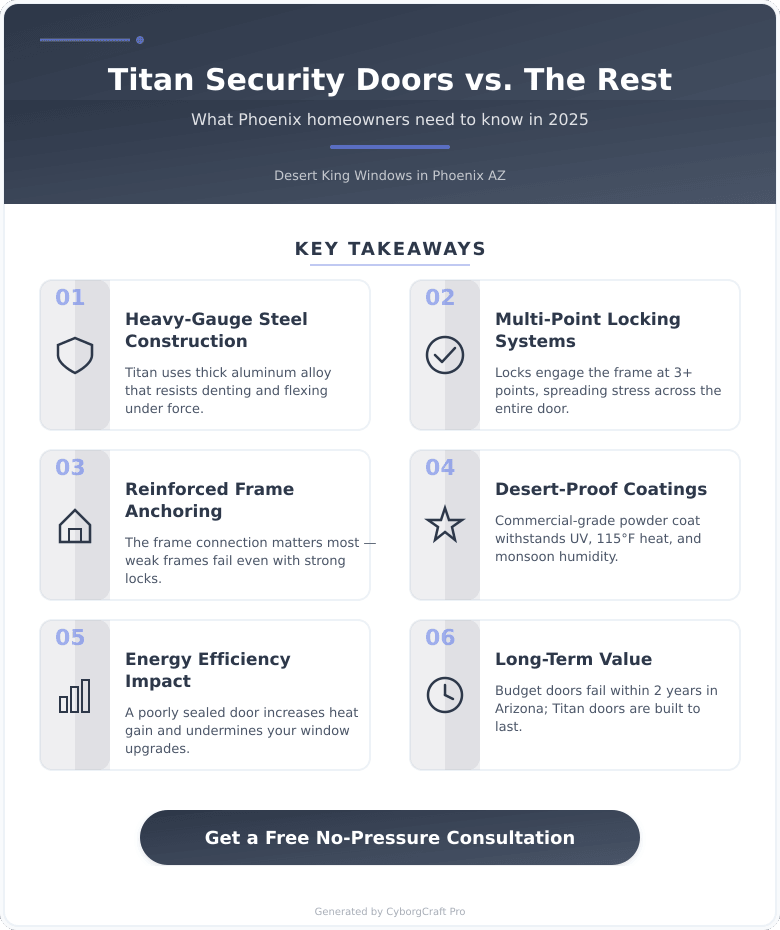
Security doors in Phoenix and Scottsdale are reinforced entryway barriers designed to resist forced entry, withstand extreme heat, and provide long-term durability in desert climates. Titan security doors represent the premium tier of this category, built with heavier steel gauges, multi-point locking systems, and finishes engineered specifically for Arizona’s punishing conditions.
This guide focuses specifically on how Titan security doors compare to standard options, what Phoenix and Scottsdale homeowners should look for in 2025, and how to make the right call before you buy.
Security Door Definition: A security door is a heavy-duty exterior door built from reinforced steel or wrought iron, featuring a solid core, reinforced frame, and advanced locking mechanisms to deter and delay unauthorized entry.
At Desert King Windows in Phoenix AZ, we see a lot of homeowners who bought a budget security door and came back frustrated within two years. The finish had bubbled, the frame had warped, or the lock mechanism stopped engaging cleanly. Security doors in Phoenix and Scottsdale face conditions most doors were never designed for – 115-degree summers, UV radiation that breaks down coatings fast, and monsoon-season humidity swings that stress every joint and seal.
Why Standard Security Doors Fall Short in the Arizona Desert
Most security doors sold at big box stores are built to a price point, not a performance standard. They use thinner steel, powder coatings applied in a single thin layer, and basic locking systems. In a mild climate, that might be fine. In Phoenix and Scottsdale, it’s a recipe for early failure.
Exterior doors and entry points play a meaningful role in residential heat gain in hot climates, making door quality a direct factor in both comfort and energy costs. A poorly sealed security door can undo a lot of what your windows are doing right.
Residential break-in attempts commonly target front and back entryways, with weak frame anchoring often being a key vulnerability rather than the lock itself. A door is only as strong as how it’s attached to the structure around it.
The most common mistake we see is homeowners focusing on the lock and ignoring the frame. A multi-point lock on a flimsy frame still fails under a single hard kick. Titan doors address this at the frame level, not just the hardware level.
Thinking about upgrading your entry door? Contact us for a no-pressure walkthrough of your options. We’ll tell you honestly what makes sense for your home and your budget.
Titan Security Doors vs. Standard Security Doors: Which Approach Works?
Where Titan security doors succeed: Titan security doors are made from heavy-duty aluminum alloy and feature multi-point locking systems for enhanced security. Multi-point locking systems engage the frame at three or more points simultaneously. Commercial-grade powder coat finishes hold up against UV exposure and extreme heat without peeling or fading through multiple Phoenix summers.
Where Titan security doors fall short: Higher upfront cost puts them out of reach for some budgets. Custom sizing or finishes may require additional lead time depending on specifications. Heavier doors require proper installation – a poorly hung Titan door is worse than a properly hung standard door.
Where standard security doors succeed: Lower price point makes them accessible. Available immediately at most retailers. Lighter weight makes DIY installation more feasible for handy homeowners.
Where standard security doors fail: Thin gauge steel dents and flexes. Single-point locks concentrate stress on one frame section. Coatings may degrade more quickly in harsh Arizona conditions. Frame anchoring is typically minimal.
The verdict: For Phoenix and Scottsdale homeowners who plan to stay in their homes and want a door that performs through 2026 and beyond, Titan is the better investment. Standard security doors are acceptable for short-term rentals or tight budgets, but the replacement cycle costs more over time.
Brand Comparison: Security Door Options for Phoenix Homeowners
| Brand | Steel Gauge | Locking System | Price Range (2025) | Warranty | Best For |
|---|---|---|---|---|---|
| Titan | 14-gauge | Multi-point (3+) | $800 – $1,800 | Manufacturer warranty applies | Long-term performance, desert climates |
| Emtek | 16-gauge | Single or double point | $600 – $1,400 | 10-year finish | Aesthetic variety, moderate security |
| Malibu Security | 16-gauge | Single-point deadbolt | $400 – $900 | 5-year limited | Budget-conscious buyers |
| Iron Age | 14-gauge | Multi-point | $700 – $1,600 | Lifetime frame | Ornamental iron look with strength |
| Steel Craft | 18-gauge | Single-point | $300 – $700 | 3-year limited | Short-term or rental properties |
What to Look For When Buying a Security Door in Phoenix or Scottsdale
Steel gauge: The lower the gauge number, the thicker the steel. Anything 18-gauge or higher (numerically) is too thin for long-term desert use. Stick with 14-16 gauge for serious security.
Multi-point locking: A true multi-point system engages deadbolts into the frame at the top, middle, and bottom when you turn the key. This distributes force and makes kick-in attacks far less effective.
Frame anchoring: The door frame should be anchored into structural framing with 3-inch screws minimum, not just into drywall. Ask any installer specifically how they anchor the frame before you agree to the job.
Finish quality: Look for a polyester or TGIC powder coat finish rated for UV exposure. In Scottsdale and Phoenix, the sun destroys thin finishes fast. Titan uses a multi-stage application process that holds color and adhesion significantly longer than single-coat competitors.
According to general industry estimates, homeowners who upgrade to a heavy-gauge multi-point security door see a meaningful reduction in successful forced-entry attempts compared to properties with standard entry doors – frame integrity is the deciding factor in most cases.
Your Security Door Selection Checklist
- Step 1 – Assess your entry points: Identify which doors face the highest risk – front door, back door, side gate. Not every opening needs the same level of door.
- Step 2 – Measure your rough opening: Standard sizes are 32×80 and 36×80, but older Phoenix homes often have non-standard openings. Measure before you shop.
- Step 3 – Choose your steel gauge: For primary entry doors in Phoenix and Scottsdale, 14-gauge is the right call. 16-gauge works for secondary doors.
- Step 4 – Confirm multi-point locking: Verify the lock system engages at a minimum of three points. Ask to see the mechanism demonstrated before purchase.
- Step 5 – Verify installer credentials: Arizona requires licensing for contractors doing structural work. Confirm your installer holds a valid ROC (Registrar of Contractors) license before any work begins.
- Step 6 – Check finish warranty: A credible manufacturer backs the finish for at least 5-10 years. Anything shorter is a sign of lower-quality coating.
- ☐ Door measured for exact rough opening size
- ☐ Steel gauge confirmed at 14-16 gauge
- ☐ Multi-point lock system verified
- ☐ Frame anchoring method discussed with installer
- ☐ Finish warranty reviewed
- ☐ Installer ROC license verified
Permits, Rebates, and Arizona-Specific Factors in 2025
In most Phoenix and Scottsdale jurisdictions, replacing an existing door in the same opening does not require a permit. However, widening the opening or changing the structural framing typically triggers a permit requirement under current Arizona building code (2025). If you’re unsure, the City of Phoenix Development Services Department can confirm in a quick call.
As of 2025, some Arizona utility companies including APS offer rebates tied to overall home envelope improvements. A new insulated security door may qualify as part of a broader upgrade package – worth checking before you finalize your order. Eligibility and dollar amounts vary, so confirm directly with your utility provider for current 2025 limits.
For homes in Scottsdale’s historic or HOA-governed neighborhoods, check your CC&Rs before ordering a custom finish or ornamental style. Some communities have specific approval processes for visible exterior changes.
Key Takeaways for Phoenix and Scottsdale Homeowners in 2025
- Steel gauge matters most – 14-gauge Titan construction resists forced entry and desert heat far better than thin-gauge alternatives.
- Multi-point locking is non-negotiable – single-point deadbolts concentrate stress and fail faster under pressure.
- Frame anchoring is the real weak point – most break-ins exploit weak frames, not locks.
- Finish quality directly affects lifespan – UV-rated powder coat keeps your door looking and performing well through multiple Arizona summers.
- Professional installation makes the difference – a Titan door hung incorrectly is worse than a standard door hung properly.
Frequently Asked Questions
How much do security doors cost in Phoenix and Scottsdale in 2025?
Security doors in Phoenix and Scottsdale typically range from $300 to $1,800 depending on steel gauge, brand, and locking system. Titan doors with installation generally fall between $900 and $2,000 total. Budget options from big box stores start lower but often require replacement sooner in Arizona’s climate.
Do I need a permit to install a security door in Phoenix?
Replacing a security door in the same rough opening typically does not require a permit in Phoenix under current 2025 code. Structural modifications to the opening do trigger permit requirements. Confirm with the City of Phoenix or your local jurisdiction before starting work.
How long does security door installation take?
A straightforward security door installation in an existing opening typically takes 2-4 hours on the day of installation. Custom-ordered Titan doors may require additional lead time from order to installation appointment, depending on size and finish selection.
What makes Titan security doors better for Arizona’s heat?
Titan security doors use thicker steel, multi-stage UV-resistant powder coat finishes, and tighter frame sealing designed to handle temperature extremes above 110 degrees. Standard doors often develop finish bubbling and frame warping after just a few Arizona summers, while Titan’s construction holds up significantly longer.
How do I verify a security door installer is licensed in Arizona?
Arizona contractors must hold a valid ROC (Registrar of Contractors) license, which you can verify for free at the Arizona ROC website. Always ask for the license number before signing any contract. Bonding and liability insurance should also be confirmed before work begins.
Are security doors worth it for Scottsdale and Phoenix homes?
Yes – heavy-gauge security doors provide measurable deterrence against forced entry and add resale value in the Phoenix and Scottsdale market. Beyond security, a properly sealed door reduces heat gain, which directly affects cooling costs during Arizona summers. The ROI is strong for homeowners planning to stay 5 or more years.
Ready to Choose the Right Security Door for Your Home?
You’ve got the full picture now – what separates a Titan door from a budget option, what to look for in steel gauge and frame anchoring, and what the Phoenix and Scottsdale market looks like in 2025. The next step is straightforward.
Ready to take the next step? Contact us today for straight answers and a free estimate. We serve homeowners throughout the Phoenix metro area including Scottsdale, Chandler, Tempe, Mesa, Gilbert, Glendale, and Peoria. Come see us at 2615 S 21st St, Phoenix, AZ 85034, or reach out online and we’ll set up a time that works for you.
For a complete overview of what we offer, visit our services page or head back to the Desert King Windows in Phoenix AZ homepage to see the full range of products we carry.
Recent posts
 Vinyl vs. Fiberglass Windows in Arizona: An Honest Desert ComparisonSeptember 28, 2026
 Why Vinyl Windows Are the Smart, Low-Maintenance Choice for Las Vegas HomesSeptember 25, 2026
 Entry-Door Replacement in Phoenix: Curb Appeal That Can Take 115 DegreesSeptember 21, 2026
 The Federal Window Tax Credit Ended – How Las Vegas Homeowners Can Still Save in 2026September 18, 2026