

Vinyl vs. Fiberglass Windows in Las Vegas: Which Frame Material Actually Survives 115-Degree Mojave Desert Summers
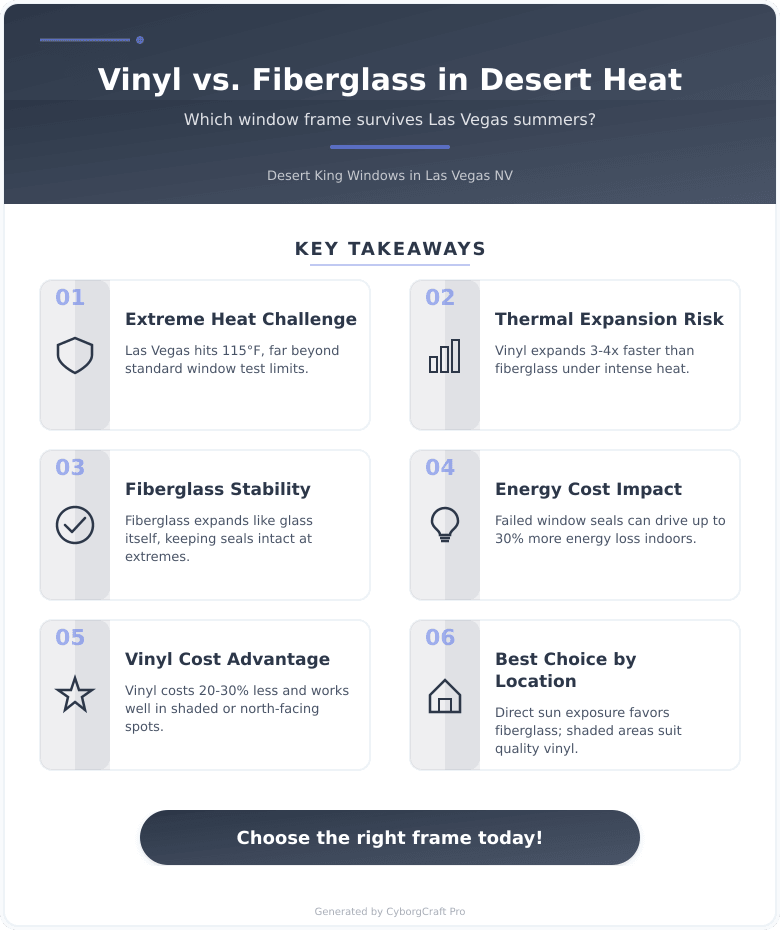
Vinyl vs. fiberglass windows is a comparison of two popular window frame materials that perform very differently under extreme desert heat. For Nevada homeowners, choosing the wrong material can mean warped frames, failed seals, and skyrocketing energy bills within just a few summers.
This guide focuses specifically on how vinyl and fiberglass window frames perform under the extreme heat conditions found in the Mojave Desert, helping Las Vegas homeowners make a confident, informed decision.
Window Frame Material Definition: A window frame material is the structural component that holds the glass unit in place, determines thermal performance, and controls how well the window resists expansion, warping, and UV degradation over time.
Most window guides talk about climate in vague terms. But Las Vegas is not a vague climate. Summers here regularly push past 110 degrees Fahrenheit, and rooftop surfaces and south-facing walls can reach 160 degrees or higher. The most common mistake homeowners make is buying windows rated for a “warm climate” without asking what that window does at 115 degrees specifically. That gap is where problems start.
Why Desert Heat Destroys Average Windows
Standard windows sold across the country are typically tested to perform in temperature ranges up to 90 or 100 degrees. Las Vegas summers blow past that range regularly. According to the U.S. Department of Energy, windows account for up to 30% of residential heating and cooling energy use, and that number climbs significantly in extreme heat zones when frames fail to maintain their seal.
Frame expansion is the core problem. Every material expands when heated. The question is how much, how evenly, and whether it snaps back to its original shape when temperatures drop overnight. In Las Vegas, that daily swing from 115 degrees at 3 PM to 75 degrees at midnight puts enormous stress on every component of a window system.
Thermal expansion coefficient: A measurement of how much a material expands per unit of length for each degree of temperature increase. Lower numbers mean less movement and less stress on the frame and seal.
Vinyl vs. Fiberglass Windows: Which Approach Works?
Where vinyl succeeds: Lower upfront cost, widely available, decent insulation when the frame cavity is foam-filled, and good resistance to moisture and corrosion. Vinyl is the most common residential window material sold in Nevada for a reason.
Where vinyl fails: Vinyl expands at roughly 3-4 times the rate of fiberglass under heat. In sustained temperatures above 100 degrees, cheaper vinyl profiles can soften, warp slightly, or lose their tight seal with the glass unit. Over several summers, this translates to air leakage and condensation between panes.
Where fiberglass succeeds: Fiberglass expands at nearly the same rate as glass itself, which is why the seal between frame and glass unit stays intact even at extreme temperatures. It is dimensionally stable, doesn’t soften under heat, and holds paint or finish without peeling. Fiberglass frames are also significantly stronger, which allows thinner profiles and more glass area.
Where fiberglass fails: Cost. Fiberglass windows typically run 20-30% more than comparable vinyl units. Installation availability is narrower, and not every contractor stocks or installs them regularly.
The verdict: For a home in Henderson, Summerlin, or North Las Vegas that faces direct sun exposure for 6 or more hours daily, fiberglass is the stronger long-term investment. For shaded or north-facing installations, high-quality vinyl with foam-filled frames performs well and saves money up front.
Brand Comparison: What the Market Offers in 2025
BrandFrame TypePrice Per Window (2025)U-FactorBest ForAndersen 100 SeriesFibrex (composite)Pricing varies by size and installationConfirm current ratings with your installerDurability, desert climatesMilgard TuscanyVinylPricing varies by size and installationConfirm current ratings with your installerValue, shaded exposuresPella 250 SeriesVinyl$320 – $7000.26 – 0.30Mid-range efficiencyInfinity by MarvinFiberglassPricing varies by size and installationConfirm current ratings with your installerHigh-heat, premium homesSimonton ReflectionsVinyl$280 – $5800.30 – 0.35Budget-conscious replacement
Thinking about this for your situation? Let’s talk. The team at Desert King Windows in Las Vegas NV will walk you through your options with no pressure and straight answers.
Nevada Tax Credits and Rebates for 2025
The federal Energy Efficient Home Improvement Credit (Section 25C) allows Nevada homeowners to claim up to $600 annually for qualifying windows under Section 25C (part of a $1,200 annual cap for certain improvements). Windows must meet ENERGY STAR Most Efficient criteria, which typically means a U-factor of 0.25 or lower and an SHGC of 0.25 or lower for most of Clark County.
NV Energy also runs periodic rebate programs for qualifying window upgrades. Amounts vary by program cycle, so check directly with NV Energy or ask your installer to confirm current availability before scheduling your project.
- Federal tax credit: up to $600 per year for windows under Section 25C (part of $1,200 total for certain improvements)
- NV Energy rebates: varies by program cycle
- ENERGY STAR Most Efficient certification required for both programs
- Clark County may require a building permit for full-frame window replacement
Your Window Replacement Action Plan
- Step 1 – Assess your exposure: Walk your home and note which windows face south or west. These get the most direct desert sun and are where frame quality matters most.
- Step 2 – Set your budget range: Fiberglass runs higher up front but saves more over a 15-20 year lifespan. Vinyl is a solid choice for shaded or budget-sensitive installations.
- Step 3 – Confirm ENERGY STAR ratings: Ask for the NFRC label showing U-factor and SHGC. For Las Vegas, target U-factor under 0.30 and SHGC under 0.25.
- Step 4 – Verify contractor credentials: Nevada requires window installers to hold a valid contractor’s license through the Nevada State Contractors Board (NSCB). Ask for the license number and verify it at nvcontractorsboard.com.
- Step 5 – Pull permits if required: Full-frame replacements in Clark County typically require a building permit. Insert-only replacements may not. Confirm with your installer before work begins.
- Step 6 – Schedule for off-peak heat: October through March is the best window for installation. Cooler temps mean better frame seating and caulk adhesion.
Ready to take the next step? Contact us at Desert King Windows, located at 4224 Arcata Way Unit H, North Las Vegas, NV 89030, for a free estimate and honest recommendation based on your home’s actual exposure.
Key Takeaways for Nevada Homeowners in 2025
- Frame material matters more in Las Vegas than nearly anywhere else – extreme heat cycles stress every component of a window system
- Fiberglass outperforms vinyl in direct, high-heat exposures due to its low thermal expansion rate and dimensional stability
- High-quality vinyl is still a smart choice for shaded, budget-sensitive, or north-facing installations
- Federal tax credits up to $600 are available in 2025 for ENERGY STAR-certified replacements
- Always verify Nevada contractor licensing through the NSCB before signing any contract
Frequently Asked Questions
How much do fiberglass windows cost compared to vinyl in Nevada?
Fiberglass windows typically cost 20-30% more than vinyl, with installed prices ranging from $600 to $1,100 per window versus $280 to $700 for vinyl in 2025. The higher upfront cost is often offset by longer lifespan and better performance in extreme heat climates like Las Vegas.
Do vinyl windows warp in Las Vegas heat?
Lower-grade vinyl profiles can soften or slightly warp when sustained temperatures exceed 100 degrees Fahrenheit, particularly on south and west-facing exposures. Higher-quality vinyl with foam-filled frames and reinforced profiles performs considerably better and is a reasonable choice for many Las Vegas homes.
What U-factor should I look for in a Las Vegas window?
For Las Vegas, target a U-factor of 0.30 or lower and a Solar Heat Gain Coefficient (SHGC) of 0.25 or lower. These ratings align with ENERGY STAR requirements for the hot-dry climate zone and qualify for the federal 25C tax credit.
Do I need a permit to replace windows in Clark County?
Full-frame window replacements in Clark County generally require a building permit, while insert-style replacements into existing frames may not. Always confirm with your installer and the Clark County Building Department before work starts.
How long does a window replacement project take in Las Vegas?
Most residential window replacement projects in Las Vegas take one to two days for a standard home of 10-15 windows, including installation and cleanup. Lead times for ordering custom sizes can add two to four weeks before the installation date.
Which neighborhoods does Desert King Windows serve?
Desert King Windows serves homeowners throughout the greater Las Vegas area, including North Las Vegas, Henderson, Summerlin, Spring Valley, Enterprise, and surrounding Clark County communities. Reach out through our contact page to confirm availability in your area.
About the Author
The Desert King Windows Team, window installation professionals in North Las Vegas, NV. We help homeowners across Clark County choose and install the right windows for the unique demands of the Mojave Desert climate. For more information, visit our homepage or explore our services.
Recent posts
 Security Screen Doors in Arizona: Airflow, Style, and Protection for Desert HomesSeptember 14, 2026
 Window Financing in Las Vegas: Replace Your Windows Without Paying All at OnceSeptember 11, 2026
 Patio Door Installation in Phoenix: Getting Sliding and French Doors Done RightSeptember 7, 2026
 Noise-Reduction Windows for Homes Near the Strip, Reid Airport, and I-15September 4, 2026