

The Real Reason Your San Antonio Home Gets So Hot Even With the AC Running – It’s Probably Your Windows
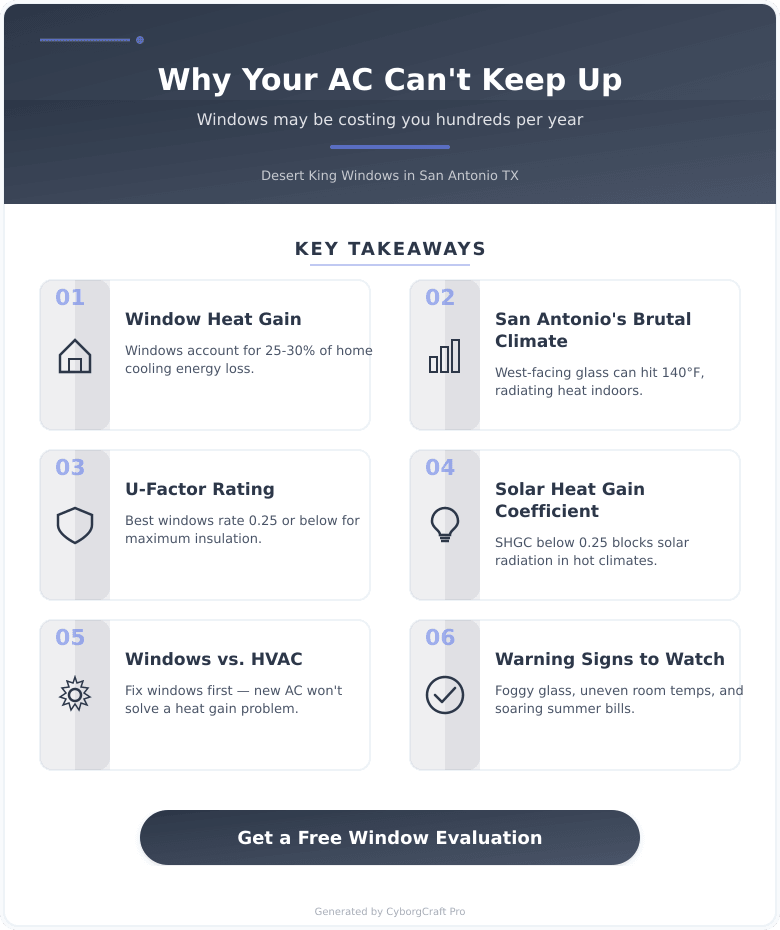
Window heat gain is the process by which solar radiation and outdoor heat transfer through glass and window frames directly into your living space, raising indoor temperatures regardless of how hard your air conditioner works. In a city where summer temperatures regularly push past 100 degrees, this single issue can quietly cost you hundreds of dollars a year while leaving you sweaty and frustrated.
This guide focuses specifically on why windows are the primary source of heat gain in South Texas homes and what homeowners can do about it in 2025.
Window Heat Gain Definition: The measurable transfer of solar energy and radiant heat through window glass, frames, and seals into a home’s interior, which forces HVAC systems to work harder and raises cooling costs significantly.
The most common mistake we see is homeowners blaming their AC unit when their system is actually working fine. The problem is that the heat keeps pouring in faster than the AC can remove it. That is a window problem, not a mechanical one. According to the U.S. Department of Energy, heat gain and loss through windows accounts for 25 to 30 percent of residential heating and cooling energy use.
Why San Antonio Summers Punish the Wrong Windows
South Texas sits in a climate zone that combines intense solar radiation, high humidity, and long cooling seasons. That combination is brutal on older single-pane or low-quality double-pane windows. When direct sun hits west and south-facing glass between noon and 7 p.m., indoor surface temperatures on those windows can exceed 140 degrees Fahrenheit. That heat radiates straight into your rooms whether the AC is on or not.
Recent data shows that the average San Antonio home built before 2005 still has windows with a U-factor above 0.40, which means they are transferring heat at nearly double the rate of current Energy Star-rated products. Current best practices for hot climates call for windows with a U-factor at or below 0.25 and a Solar Heat Gain Coefficient (SHGC) below 0.25.
U-factor: A rating that measures how well a window prevents heat from escaping or entering a home – lower numbers mean better insulation performance.
Solar Heat Gain Coefficient (SHGC): A number between 0 and 1 that measures how much solar radiation a window allows into a home – lower means less heat coming through the glass.
Window Heat Gain vs. Poor HVAC: Which Problem Do You Actually Have?
Where window heat gain succeeds as a diagnosis: Rooms on the west or south side feel drastically hotter than the rest of the house. Your AC runs almost continuously but never quite catches up. Your energy bills spike sharply from June through September. You feel radiant warmth standing near windows even with blinds closed.
Where window heat gain fails as the full explanation: If your entire home is uniformly hot, ductwork leaks or undersized equipment may also be contributing. Attic insulation problems can compound window issues significantly.
Where HVAC failure succeeds as the right answer: Your system is over 15 years old and struggles in every room equally. You hear unusual noises or notice refrigerant leaks. The air coming from your vents is not cold.
Where HVAC replacement falls short: Replacing the AC unit without addressing window heat gain means your new system will face the same overload. Contractors report that many homeowners who upgraded their AC in 2024 still saw identical energy bills because the windows were never addressed.
The verdict: Get your windows evaluated before spending money on HVAC upgrades. If your windows have a high SHGC or visible seal failures, fixing them first will produce immediate and measurable results without a full system replacement.
Thinking about this for your situation? Let’s talk. Contact us and we will walk you through your options – no pressure.
Warning Signs Your Windows Are the Real Culprit
- Condensation or fogging between glass panes (failed seal, no insulating gas)
- Rooms facing west or southwest that feel like an oven by afternoon
- Window frames that are hot to the touch on the interior side
- Visible gaps, cracks, or failing caulk around the frame perimeter
- Single-pane glass – still common in homes built before the 1990s
- Energy bills that climb 30 percent or more between spring and summer
Window Performance Brand Comparison for Hot Climates (2025)
| Brand | Product Line | U-Factor | SHGC | Price Range Per Window | Best For |
|---|---|---|---|---|---|
| Andersen | 400 Series Low-E | 0.27 | 0.22 | $450 – $850 | Classic look, proven durability |
| Simonton | Reflections 5500 | 0.24 | 0.20 | $300 – $650 | Budget-friendly hot-climate performance |
| Milgard | Tuscany Series | 0.25 | 0.21 | $350 – $700 | Southwest homes, lifetime warranty |
| PGT Innovations | WinGuard Vinyl | 0.23 | 0.19 | $400 – $800 | Impact resistance plus heat control |
| Pella | 250 Series | 0.26 | 0.23 | $380 – $750 | Mid-range all-around performer |
According to Energy Star, windows meeting the South-Central climate zone specifications can reduce cooling energy use by up to 15 percent compared to standard double-pane products.
Your Window Heat Gain Action Plan
- Step 1 – Identify problem windows: Walk your home at 3 p.m. on a sunny day and hold your hand six inches from each window. Windows radiating noticeable heat are the priority. Note which rooms face west or southwest.
- Step 2 – Check for seal failure: Look for clouding or moisture between glass panes. Failed seals mean the insulating argon or krypton gas has escaped, cutting efficiency dramatically.
- Step 3 – Measure your current specs: Find the NFRC label on your existing windows. If the U-factor is above 0.35 or SHGC is above 0.30, replacement will produce measurable savings in the Texas climate.
- Step 4 – Get a licensed contractor quote: Texas does not require a specific window installer license, but verify general contractor licensing through the Texas Department of Licensing and Regulation and confirm the company carries liability insurance and a workmanship warranty.
- Step 5 – Apply for available rebates: CPS Energy in Bexar County offers rebates for qualifying window replacements in 2025. Check current program limits at cpsenergy.com since funding levels adjust seasonally.
- Step 6 – Schedule installation before peak season: Book window replacement in late winter or early spring to avoid the June through August backlog when demand spikes across the region.
Texas Rebates and Tax Credits for Window Replacement (2025)
The federal Energy Efficient Home Improvement Credit allows homeowners to claim 30 percent of qualifying window costs up to $600 per year (2025 limits) when replacing windows that meet Energy Star Most Efficient criteria. This applies to primary residences and can be claimed on your 2025 federal return.
CPS Energy serves most of the Bexar County area and runs periodic rebate programs for qualifying window upgrades. Program availability and dollar amounts shift throughout 2025, so confirming current eligibility before purchasing is the right call.
Pre-Installation Checklist
- ☐ Confirm window NFRC ratings meet Energy Star South-Central zone requirements
- ☐ Verify contractor carries current liability insurance (request certificate of insurance)
- ☐ Check if a building permit is required through the City of San Antonio Development Services Department
- ☐ Confirm manufacturer warranty covers glass seal failure for at least 10 years
- ☐ Ask for written workmanship warranty separate from the product warranty
- ☐ Document existing window condition with photos before installation begins
At Desert King Windows in San Antonio TX, we work with homeowners across Bexar County – including neighborhoods in Southside, Westover Hills, Helotes, Leon Valley, and Converse – to identify exactly where heat gain is happening and match the right product to each home. Our services page covers the full range of window and door solutions available for South Texas homes.
Key Takeaways for San Antonio Homeowners in 2025
- Windows cause 25-30 percent of home heat gain – fixing them before upgrading your AC is the smarter sequence
- SHGC below 0.25 is essential for the South-Central climate zone – standard double-pane glass rarely meets this threshold
- Failed window seals eliminate most insulating value – fogged glass is a sign you have already lost performance
- Federal tax credits cover 30 percent of qualifying costs up to $600 in 2025 – worth applying before year end
- Spring installation avoids peak-season delays – booking early in 2025 locks in faster scheduling and better contractor availability
Frequently Asked Questions
How much does window replacement cost in the San Antonio area?
Window replacement in the Bexar County area generally runs between $300 and $850 per window installed, depending on size, material, and glass package selected (2025 market rates). Full-home projects covering 10 to 15 windows typically see per-unit costs drop slightly due to volume. Frame material, Low-E coating tier, and contractor labor rates all affect final pricing.
Does Low-E glass actually make a difference in Texas heat?
Low-E (low emissivity) glass is one of the most impactful window upgrades available for hot climates because it reflects infrared radiation without reducing visible light. In South Texas conditions, a properly spec’d Low-E coating can cut solar heat gain through the glass by 40 to 70 percent compared to clear double-pane. The specific coating matters – look for products rated for hot climates, not cold-climate Low-E which works differently.
Do I need a permit to replace windows in San Antonio?
Permit requirements depend on the scope of work – like-for-like window replacements in the same opening typically do not require a permit in San Antonio, but structural changes or enlarging an opening do. Confirm specifics with the City of San Antonio Development Services Department before work begins, since requirements can change and violations create problems at resale.
How long does window replacement take?
A typical full-home window replacement project covering 10 to 15 windows takes one to two days for installation once the products arrive. Lead times for custom-sized windows in 2025 run three to six weeks from order to delivery, so total project timeline from contract to completion is usually four to eight weeks.
Will new windows really lower my energy bill?
Homeowners who replace high-SHGC windows with Energy Star-rated products in hot climates typically see cooling cost reductions of 10 to 20 percent annually. Results vary based on how many windows were underperforming, home orientation, and shading. West and southwest-facing windows produce the biggest savings because of afternoon sun exposure.
How do I verify a window contractor is legitimate in Texas?
Search the Texas Department of Licensing and Regulation database to verify any contractor license claims and always request a current certificate of general liability insurance before signing anything. Ask specifically for a separate workmanship warranty in writing – this covers installation errors that a manufacturer warranty does not address.
Ready to Stop Cooling the Outdoors?
Your AC is not the problem. Your windows probably are. The good news is that replacing the right windows in your home produces results you can measure – lower bills, more comfortable rooms, and an AC that finally catches up on the hottest afternoons.
Ready to take the next step? Contact us today for straight answers and a real look at what is happening with your home’s heat gain. The team at Desert King Windows serves homeowners throughout the San Antonio area at 1890 S Brazos St, San Antonio, TX 78207 – and we are here to help you figure out exactly what your home needs, not just sell you something.
Recent posts
 Vinyl vs. Fiberglass Windows in Arizona: An Honest Desert ComparisonSeptember 28, 2026
 Why Vinyl Windows Are the Smart, Low-Maintenance Choice for Las Vegas HomesSeptember 25, 2026
 Entry-Door Replacement in Phoenix: Curb Appeal That Can Take 115 DegreesSeptember 21, 2026
 The Federal Window Tax Credit Ended – How Las Vegas Homeowners Can Still Save in 2026September 18, 2026