
This guide focuses specifically on how inefficient windows drain cooling budgets in Scottsdale and Paradise Valley, what the data actually shows, and what changes make the biggest difference.
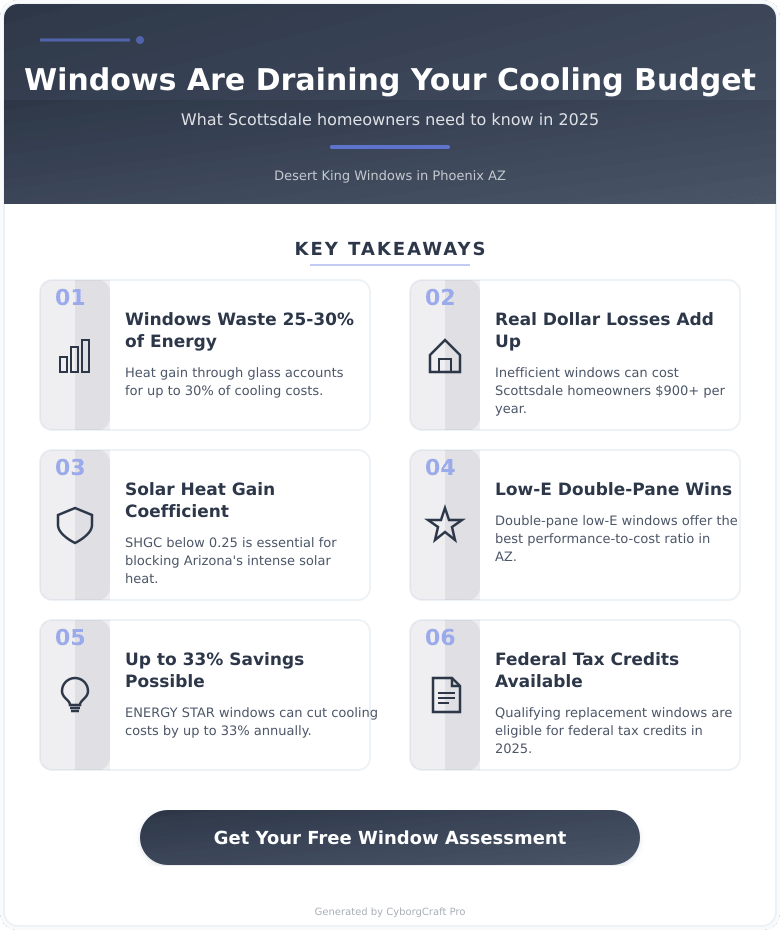
According to the U.S. Department of Energy, heat gain and loss through windows accounts for 25 to 30 percent of residential heating and cooling energy use. In a market like Scottsdale or Paradise Valley – where summer temperatures regularly exceed 110 degrees and AC runs for six or more months – that number translates to real money leaving your wallet every single month.
The most common mistake homeowners make is assuming their windows are fine because they look intact. A window can be physically undamaged and still be thermally useless. That is where the hidden cost lives.
What the Numbers Actually Look Like for Scottsdale Homeowners
Here is how the math works. If your annual electricity bill runs $3,600 – which is conservative for a 2,500-square-foot home in the Phoenix metro – and 25 percent of that is window-related heat gain, you are spending $900 per year on energy that is escaping or entering through your glass. For larger homes in Paradise Valley, that figure climbs fast.
According to the ENERGY STAR program, certified replacement windows in hot climates can reduce cooling energy costs by 12 to 33 percent. On a $3,600 annual bill, 33 percent savings equals roughly $1,188 back in your pocket every year.
Solar Heat Gain Coefficient (SHGC): A rating between 0 and 1 that measures how much solar radiation passes through a window – the lower the number, the less heat enters your home.
U-Factor: A rating measuring how well a window insulates against heat transfer – lower values mean better insulation performance in both hot and cold conditions.
In Scottsdale and Paradise Valley, you want windows with an SHGC below 0.25 and a U-Factor at or below 0.30 for meaningful cooling savings. Most older single-pane windows have SHGC ratings above 0.60 – meaning more than half of the solar energy hitting that glass walks straight into your living room.
Single-Pane vs. Double-Pane vs. Triple-Pane: Which Approach Works?
Where single-pane windows succeed: Low upfront cost, easy replacement for historic homes, widely available.
Where single-pane windows fail: SHGC often above 0.60, no meaningful insulation layer, frames conduct heat directly into interiors, and they are a major liability in 110-degree summers.
Where double-pane low-E windows succeed: Argon-filled cavities reduce heat transfer significantly, low-E coatings block infrared radiation, SHGC ratings as low as 0.19 are achievable, and they qualify for federal tax credits in 2025.
Where double-pane low-E windows fail: Higher upfront investment than single-pane, and seal failures over time can reduce efficiency.
Where triple-pane windows succeed: Maximum insulation, ideal for rooms with intense western or southern exposure.
Where triple-pane windows fail: Heavier frames require structural consideration, and higher cost may not deliver proportional returns in Arizona compared to colder climates.
The verdict: For Scottsdale and Paradise Valley homeowners, double-pane low-E windows with argon fill and an SHGC below 0.25 deliver the best balance of performance, cost, and return on investment in 2025. Triple-pane is worth considering for rooms with extreme sun exposure.
Thinking about this for your home? Contact us and we will walk you through your options – no pressure, just straight answers.
Window Brand Comparison for Arizona Climates (2025)
| Brand | Product Line | Price Range Per Window | SHGC | Warranty | Best For |
|---|---|---|---|---|---|
| Anlin | Malibu Series | Contact dealer for current pricing | 0.19 – 0.23 | Lifetime | Hot desert climates |
| Simonton | StormBreaker Plus | $380 – $750 | 0.21 – 0.27 | Limited lifetime | Value desert performance |
| Alside | Mezzo Series | $350 – $700 | 0.22 – 0.28 | Limited lifetime | Mid-range efficiency |
| Andersen | 100 Series | $400 – $850 | 0.24 – 0.30 | 20-year | Aesthetic-focused buyers |
| Milgard | Tuscany Series | $420 – $800 | 0.20 – 0.26 | Full lifetime | Vinyl durability in heat |
Your Window Efficiency Action Plan
- Step 1 – Audit Your Current Windows: Check SHGC and U-Factor ratings on existing windows. Single-pane or windows without low-E coating are immediate candidates for replacement.
- Step 2 – Identify Problem Exposures: West and south-facing windows take the hardest solar punishment in Arizona. Prioritize these for replacement or interior solar shading.
- Step 3 – Get an Energy Assessment: A window professional can use thermal imaging to identify where heat is entering your home most aggressively.
- Step 4 – Select the Right Glass Package: Choose double-pane low-E with argon fill and an SHGC at or below 0.25 for the Phoenix metro climate zone.
- Step 5 – Verify Permit Requirements: In Scottsdale and Paradise Valley, window replacements that change the opening size typically require a permit. Like-for-like replacements often do not, but confirm with your city before starting.
- Step 6 – Claim Available Credits: Qualifying energy-efficient windows may be eligible for up to 30% of cost (max $600) under the Energy Efficient Home Improvement Credit. Arizona residents should check with their utility provider and a qualified tax advisor for any additional incentives that may apply.
Common Mistakes That Make the Problem Worse
- Choosing windows by appearance alone without checking SHGC ratings
- Ignoring frame material – vinyl and fiberglass outperform aluminum in Arizona heat because aluminum conducts thermal energy directly into your home
- Skipping interior or exterior solar shades on west-facing glass after window replacement
- Using liquid caulk repairs as a long-term fix for failed window seals
- Not verifying that replacement windows carry ENERGY STAR certification for the Southern Climate Zone
Ready to stop losing money through your glass? Contact us today for a free estimate and honest assessment of what your windows are costing you.
Key Takeaways for Scottsdale and Paradise Valley Homeowners in 2025
- 25-30 percent of cooling costs trace directly to window heat gain according to the U.S. Department of Energy
- SHGC below 0.25 is the target spec for any replacement window in the Phoenix metro climate zone
- Federal tax credits in 2025 cover up to 30 percent of qualifying ENERGY STAR window costs
- Double-pane low-E with argon fill delivers the best return for most Arizona homes
- West and south-facing windows are the highest priority for replacement or shading upgrades
Frequently Asked Questions
How much can new windows actually reduce my cooling bill in Scottsdale?
ENERGY STAR-certified replacement windows can reduce cooling costs by 12 to 33 percent in hot climates like Scottsdale. On a typical Arizona home with a $3,600 annual energy bill, that represents $432 to $1,188 in annual savings depending on the existing windows being replaced and the upgrade selected.
Do I need a permit to replace windows in Scottsdale or Paradise Valley?
Like-for-like window replacements that do not change the rough opening typically do not require a permit in Scottsdale or Paradise Valley. Any project that changes the opening size, adds a new opening, or affects structural elements requires a permit from the city building department before work begins.
What SHGC rating do I need for Arizona windows?
Windows with an SHGC at or below 0.25 are recommended for the Phoenix metro area including Scottsdale and Paradise Valley. ENERGY STAR guidelines for the Southern Climate Zone set 0.25 as the threshold for qualifying products, which also determines federal tax credit eligibility in 2025.
Are there Arizona-specific rebates for window replacements in 2025?
Qualifying energy-efficient windows may be eligible for up to 30% of cost (max $600) under the Energy Efficient Home Improvement Credit. Arizona residents should also check with their utility provider – APS and SRP both offer periodic rebate programs for energy-efficient upgrades that may apply to qualifying window replacements.
How long does a window replacement project take in Phoenix?
Most residential window replacement projects in the Phoenix metro area take one to three days depending on the number of windows being replaced. Custom-sized or specialty windows can extend lead time by two to four weeks for manufacturing before installation begins.
How do I know if my current windows are failing?
Key signs include visible condensation between glass panes, drafts near the frame on calm days, rooms that feel significantly hotter near windows despite AC running, and rising energy bills without a clear cause. A thermal imaging scan can confirm heat transfer issues that are not yet visible to the eye.
Ready to Stop the Loss?
Every summer that passes with underperforming windows is another season of overpaying for cooling. Homes throughout Scottsdale, Paradise Valley, Tempe, Chandler, and the greater Phoenix metro are dealing with the same problem – glass that lets Arizona’s extreme heat walk right through your walls.
The team at Desert King Windows in Phoenix AZ works with homeowners across the region to find the right window solution for each home’s orientation, budget, and performance goals. We serve homeowners throughout Maricopa County including Scottsdale, Paradise Valley, Glendale, Mesa, and surrounding communities from our Phoenix location at 2615 S 21st St.
Ready to get real numbers for your home? Contact us today for a free estimate. We will tell you exactly what your windows are costing you and what it takes to fix it – no guessing, no pressure.