

Low-E Glass, Argon Fill, and U-Factor Ratings – What Window Specs Actually Matter for a Texas Home and Which Ones Are Just Marketing
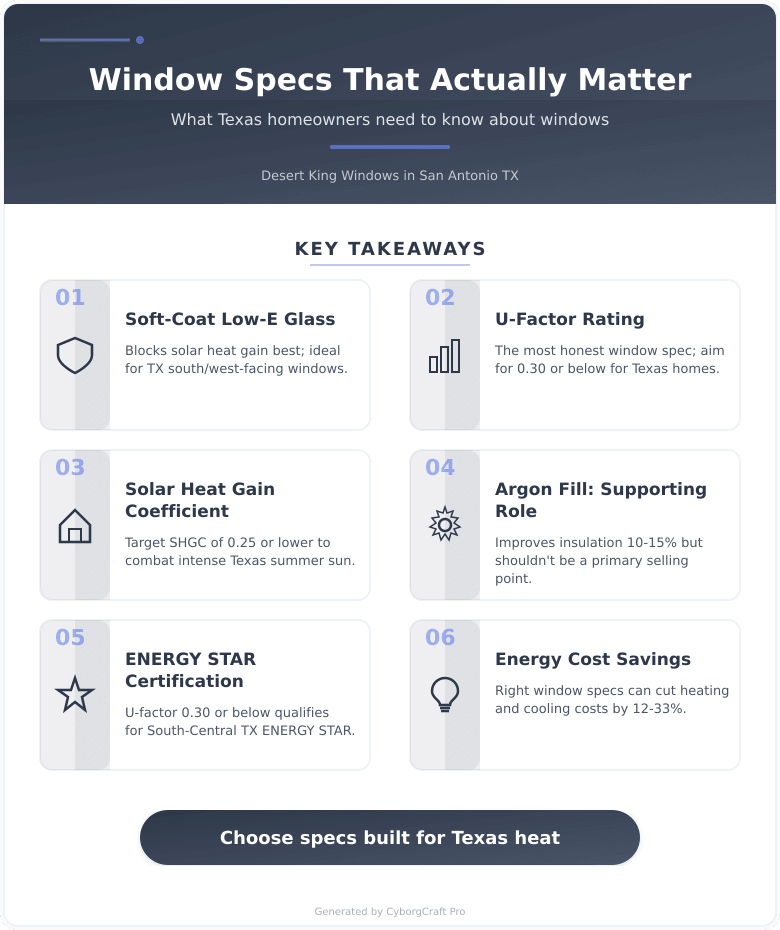
Low-E glass, argon fill, and U-factor ratings are window performance specifications that measure how well a window resists heat transfer, blocks solar radiation, and maintains indoor comfort. For Texas homeowners, choosing the right combination of these specs can mean the difference between a home that stays cool all summer and one that battles rising energy bills every month.
This guide focuses specifically on which window specifications deliver real performance benefits in South-Central Texas’s hot, humid climate – and which ones are mostly sales language.
Window shopping feels straightforward until a sales rep starts rattling off specs. Low-E coatings. Triple-pane glass. Argon fill. Warm-edge spacers. Each one sounds impressive, but not every spec carries equal weight in a Texas climate. The most common mistake homeowners make is paying a premium for features that deliver marginal returns in this specific region. According to the U.S. Department of Energy, energy-efficient windows can reduce heating and cooling costs by 12-33%, but only when the right specifications are matched to local conditions.
What Low-E Glass Actually Does (and Why It Matters in Texas)
Low-E coating definition: A microscopically thin metallic layer applied to glass that reflects infrared heat while allowing visible light to pass through.
In Texas, solar heat gain is your primary enemy from May through September. Low-E glass addresses this directly. But here is where it gets nuanced: there are two types of Low-E coatings, and they perform very differently depending on your climate.
- Hard-coat Low-E (pyrolytic) – baked into the glass during manufacturing, more durable but less effective at blocking solar heat gain
- Soft-coat Low-E (sputtered) – applied in a vacuum, significantly more effective at blocking solar radiation, ideal for hot climates
For a Texas home, soft-coat Low-E is the spec that genuinely earns its price. The difference in solar heat gain coefficient (SHGC) between a standard double-pane and a soft-coat Low-E window can be dramatic. You want an SHGC of 0.25 or lower for south and west-facing windows in San Antonio.
U-Factor Ratings – The Spec That Actually Tells You How a Window Performs
U-factor definition: A measurement of how quickly a window transfers heat from inside your home to outside (or vice versa), rated on a scale from 0.20 to 1.20 – lower numbers mean better insulation.
U-factor is arguably the most honest number on a window spec sheet. It reflects the entire window unit’s thermal performance, not just the glass. A window with a U-factor of 0.30 or below qualifies for ENERGY STAR certification in the South-Central climate zone, which includes San Antonio and the surrounding Bexar County area.
Here is what the numbers look like in practice:
| U-Factor Range | Performance Level | Texas Relevance | Typical Cost Premium |
|---|---|---|---|
| 0.20 – 0.25 | Excellent | Best for year-round comfort | 25-40% over standard |
| 0.26 – 0.30 | Good | ENERGY STAR qualified for TX | 10-20% over standard |
| 0.31 – 0.40 | Average | Marginal improvement | Minimal premium |
| 0.41+ | Poor | Similar to older single-pane | Base pricing |
Argon Fill: Real Benefit or Mostly Marketing?
Argon gas fill sits between the panes of a double or triple-pane window. It conducts heat more slowly than air, which improves U-factor by roughly 10-15%. That is a real benefit, but it is a supporting spec, not a headline feature.
Where argon fill succeeds: It genuinely improves insulation performance. It reduces condensation at the edge of the glass. It is inexpensive to include and virtually every quality window comes with it standard.
Where argon fill fails: Over time, seal quality can affect long-term performance. Marketing that leads with argon fill as a primary selling point often glosses over the fact that Low-E coating and U-factor matter far more in Texas summers.
The verdict: Argon fill is worth having, but it should not be the reason you choose one window over another. If a salesperson is leaning heavily on argon fill as the main differentiator, ask about the SHGC and U-factor instead. Those numbers tell the real performance story.
Thinking about upgrading your windows? Contact us and we will walk you through the specs that actually make a difference for your home – no pressure, just straight answers.
Your Window Spec Evaluation Checklist
- Check the SHGC first: For south and west-facing windows in Texas, target 0.25 or below to limit summer heat gain.
- Verify the U-factor: Aim for 0.30 or lower for ENERGY STAR qualification in the South-Central climate zone.
- Confirm Low-E coating type: Ask specifically whether it is hard-coat or soft-coat. Soft-coat performs better in hot climates.
- Look for the NFRC label: The National Fenestration Rating Council label provides independently verified specs, not manufacturer claims.
- Ask about the frame material: Vinyl frames resist heat transfer and require minimal maintenance in Texas humidity.
- Get the warranty in writing: A quality window should carry at least a 20-year warranty on seals and glass units.
What Texas Homeowners Should Know About Energy Credits in 2025
The federal Energy Efficient Home Improvement Credit remains available in 2025 for qualifying window replacements. Windows that meet ENERGY STAR program criteria may be eligible, and homeowners should consult current program guidelines or a tax professional to confirm coverage amounts and performance requirements. According to the ENERGY STAR program, products meeting top-tier criteria represent the highest performers in each category. CPS Energy in San Antonio also offers rebate programs for qualifying window replacements – worth checking before you commit to a project.
Texas homeowners replacing single-pane windows with ENERGY STAR certified double-pane Low-E units can see meaningful cooling load reductions, making upgrades a worthwhile investment for long-term energy savings.
Key Takeaways for Texas Homeowners in 2025
- Low-E coating type matters – soft-coat outperforms hard-coat for Texas solar heat blocking
- U-factor is your best performance indicator – target 0.30 or lower for meaningful results
- SHGC is critical for south and west windows – 0.25 or below limits summer heat gain significantly
- Argon fill is a plus, not a primary spec – do not pay extra just for this feature alone
- The NFRC label verifies claims independently – do not trust manufacturer-only specs
Frequently Asked Questions
What is the most important window specification for a Texas home?
Solar heat gain coefficient (SHGC) is the most critical spec for Texas homes because solar radiation drives most of the cooling load. A low-E coating paired with an SHGC of 0.25 or below on south and west-facing windows will reduce indoor heat gain more than any other single specification you can choose.
Does triple-pane glass make sense in San Antonio?
Triple-pane windows rarely justify their cost premium in the San Antonio climate. The primary benefit of triple-pane is improved insulation in very cold climates. In South Texas, a high-quality double-pane with soft-coat Low-E and a strong SHGC rating delivers 90% of the performance at a significantly lower price point.
How long does argon gas stay effective in window units?
Most quality window seals retain argon gas for many years before meaningful loss occurs. When seals fail, you will notice fogging or condensation between the panes, which signals it is time for glass unit replacement or full window replacement depending on frame condition.
What does the NFRC label tell me?
The NFRC (National Fenestration Rating Council) label provides independently tested and verified performance data for the entire window unit. It shows U-factor, SHGC, visible transmittance, and air leakage ratings. Always compare windows using NFRC-certified data, not manufacturer marketing sheets.
Are replacement windows eligible for tax credits in 2025?
Yes, qualifying windows may be eligible for federal tax credits in 2025 under the Energy Efficient Home Improvement Credit. Windows must meet current ENERGY STAR criteria to qualify. Keep your purchase receipts and product certification statements for tax filing, and consult a tax professional for the most up-to-date credit details.
How do I verify a window contractor is properly licensed in Texas?
Texas does not require a specific state window installation license, but contractors should carry general liability insurance and any required local business permits. Always ask for proof of insurance, check their Better Business Bureau rating, and verify any manufacturer certification they claim to hold.
Make the Right Call for Your Home
Window specs can feel overwhelming, but the core framework is straightforward: prioritize SHGC and U-factor over everything else, confirm the Low-E coating type, and verify all claims through the NFRC label. The marketing language around argon fill and triple-pane glass sounds compelling, but the numbers rarely support the premium for a Texas climate.
At Desert King Windows in San Antonio TX, we help homeowners cut through the noise and find windows that actually perform in South Texas conditions. Our team serves homeowners throughout Bexar County, including Helotes, Converse, Leon Valley, Schertz, and communities across the greater San Antonio area.
Ready to get real answers about your window options? Reach out today and we will review your home’s specific orientation, existing windows, and energy goals to recommend specs that make genuine sense – not just specs that look good on a brochure. Explore our full range of window and door services to see what is available for your home.
Recent posts
 Security Screen Doors in Arizona: Airflow, Style, and Protection for Desert HomesSeptember 14, 2026
 Window Financing in Las Vegas: Replace Your Windows Without Paying All at OnceSeptember 11, 2026
 Patio Door Installation in Phoenix: Getting Sliding and French Doors Done RightSeptember 7, 2026
 Noise-Reduction Windows for Homes Near the Strip, Reid Airport, and I-15September 4, 2026