
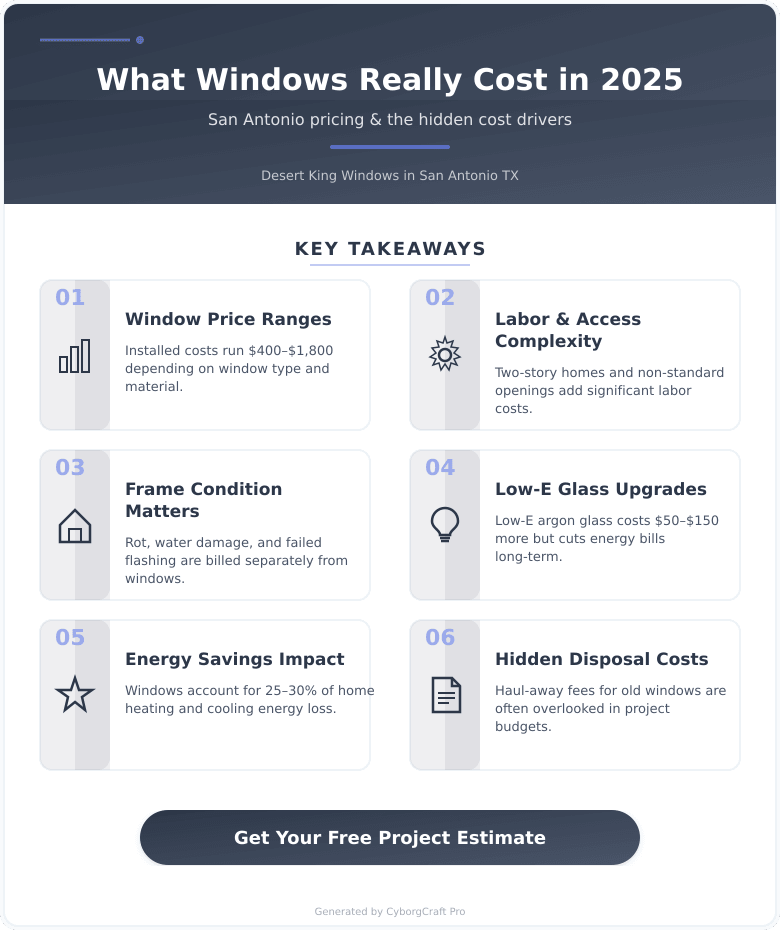
This guide focuses specifically on what San Antonio homeowners actually pay for replacement windows in 2025, and which decisions have the biggest impact on your final bill.
Most homeowners start shopping for windows with one question: what does a window cost? That’s the wrong starting point. The real question is what drives your total project cost – and the answer surprises most people. At Desert King Windows in San Antonio TX, we walk through these numbers with homeowners constantly, and the pattern is clear: the window is often the smallest variable in a replacement project.
According to the U.S. Department of Energy, heat gain and heat loss through windows accounts for 25-30% of residential heating and cooling energy use – which means the glass package you choose can affect your utility bills for the next 20 years, not just your installation invoice.
What Replacement Windows Actually Cost Per Window in 2025
Here’s a realistic price breakdown for the South Texas market as of 2025:
| Window Type | Product Cost | Installed Cost (2025) | Best For |
|---|---|---|---|
| Standard Single-Hung Vinyl | $150 – $350 | $400 – $650 | Budget replacement, rental properties |
| Double-Hung Vinyl (mid-grade) | $250 – $500 | $550 – $850 | Most residential homes |
| Casement or Picture Window | $300 – $600 | $600 – $1,000 | Better airflow, feature walls |
| Fiberglass Frame (premium) | $500 – $900 | $900 – $1,400 | Long-term durability, high-heat exposure |
| Impact-Rated Window | $600 – $1,100 | $1,000 – $1,800 | Security upgrades, storm exposure |
These ranges reflect typical South Texas pricing for 2025. A whole-home replacement project cost will vary significantly depending on the number of windows, their condition, and the factors described below.
The Factors That Move the Price More Than the Window Itself
Here’s the thing most contractors don’t explain upfront: two homes on the same street can have wildly different project costs even with identical windows. The difference comes down to four variables that have nothing to do with which product you pick.
Labor and access complexity: A straightforward swap on a single-story home costs less per window than a two-story home where scaffolding or ladders are required on every unit. In older South Texas neighborhoods where windows weren’t built to modern rough-opening standards, crews often need extra time to reframe, reshim, or reset each opening.
Frame condition and rot repair: The most common mistake we see is homeowners budgeting only for the window product and forgetting that deteriorated wood framing, water damage around the sill, or failed flashing gets billed separately. If your current windows have been leaking for years – and many South Texas windows have – expect additional repair costs per opening before the new window even goes in.
Glass package upgrades: Low-E (low-emissivity) coatings and argon gas fill are nearly essential in South Texas heat. A standard double-pane clear glass window might carry a U-factor of 0.35 or higher. A Low-E argon window can hit 0.22 or lower – and that difference shows up on your CPS Energy bill every month. The upgrade typically costs $50 to $150 more per window, but the long-term energy math almost always favors it.
Disposal and haul-away: Most homeowners don’t budget for this at all. Removing and disposing of old windows adds to your overall project cost depending on the crew, the material, and current disposal fees.
Thinking about this for your home? Let’s talk through the numbers. Contact us for a no-pressure walkthrough of what your specific project would realistically cost.
Single-Pane vs. Double-Pane: What the Comparison Actually Shows
Where single-pane windows succeed: Lower upfront cost, easier custom sizing for unusual openings, available in some historic-preservation contexts.
Where single-pane windows fail: No thermal break, radiant heat transfer is significant in Texas summers, condensation problems, higher long-term energy cost.
Where double-pane windows succeed: Dramatically better insulation, noise reduction, eligible for federal tax credits, longer product lifespan, better resale value.
Where double-pane windows fail: Higher upfront cost, seal failure over time can create fogging between panes (typically after 10-20 years), heavier units require solid framing.
The verdict: In South Texas climate conditions, double-pane Low-E windows are the practical choice for any home you plan to live in for more than three years. The energy savings and comfort improvement make the cost difference recoverable within a few years for most households.
Tax Credits and Rebates Available in 2025
Federal Energy Efficient Home Improvement Credit: Homeowners who install ENERGY STAR certified windows can claim 30% of the cost up to $600 in federal tax credits for windows per year (2025 limits under IRS Section 25C). This applies to the product cost, not installation labor.
CPS Energy rebates: CPS Energy, the primary utility serving the San Antonio area, periodically offers rebates for qualifying energy-efficient window replacements. Rebate amounts and availability change, so check current offerings directly before finalizing your project scope.
ENERGY STAR certification requirement: To qualify for either program, windows must carry ENERGY STAR Most Efficient certification for the South-Central climate zone. Look for a U-factor at or below 0.27 and a Solar Heat Gain Coefficient (SHGC) at or below 0.25 for South Texas conditions.
Your Replacement Window Action Plan
- Step 1 – Assess your current windows: Check for fogging between panes, cracked seals, difficult operation, drafts, and visible frame damage. Any of these signals replacement is overdue.
- Step 2 – Measure your openings: Get rough opening dimensions for each window. Non-standard sizes add cost – know this before you get quotes.
- Step 3 – Request itemized quotes: Ask every contractor to separate product cost, labor, disposal, and any structural repair line items. Total-only quotes hide surprises.
- Step 4 – Verify ENERGY STAR certification: Confirm the product qualifies for the 2025 federal tax credit before signing anything.
- Step 5 – Confirm licensing and insurance: Texas law requires window installers to carry general liability insurance. Ask for current certificates before work begins.
- Step 6 – Schedule strategically: Spring and early fall tend to offer better contractor availability in the South Texas market. Midsummer rush scheduling can affect both timeline and cost.
Key Takeaways for South Texas Homeowners in 2025
- Per-window installed costs vary based on conditions and glass package – the range depends more on site conditions and upgrades than brand.
- Frame repair adds real cost – older homes often need structural work around each opening before installation.
- Low-E argon glass is worth it – the energy math in South Texas heat favors the upgrade almost every time.
- Federal tax credits are available in 2025 – up to $600 for qualifying ENERGY STAR certified windows.
- Get itemized quotes – total-only bids hide labor, disposal, and repair costs until after you sign.
Frequently Asked Questions
How much do replacement windows cost per window in 2025?
Replacement window costs in South Texas vary based on window type, frame material, glass package, and installation conditions. Mid-grade double-pane vinyl windows with Low-E glass typically land between $550 and $850 per opening including labor, with premium fiberglass frames running higher.
Does the type of frame material change the price significantly?
Yes – frame material is one of the bigger cost variables in any window replacement project. Vinyl frames are the most affordable and perform well in South Texas heat. Fiberglass frames cost 30-50% more but offer greater dimensional stability and longevity in high-UV environments.
Do I need a permit to replace windows in San Antonio?
Most direct window replacements that don’t change the rough opening size don’t require a permit in San Antonio. If you’re enlarging an opening, adding a new window where none existed, or changing structural elements, a permit is required through the City of San Antonio Development Services Department.
What is a U-factor and why does it matter in Texas?
U-factor measures how quickly a window transfers heat – lower numbers mean better insulation. In South Texas, look for windows with a U-factor of 0.27 or lower, which qualifies for ENERGY STAR certification in the South-Central climate zone and federal tax credits in 2025.
How long does a window replacement project take?
Most whole-home replacement projects take one to three days for installation once windows are on-site. Lead times for custom or special-order windows currently run four to eight weeks in the South Texas market, so plan your project timeline accordingly.
Can I claim a tax credit for replacement windows in 2025?
Yes – the federal Energy Efficient Home Improvement Credit covers 30% of qualifying window costs up to $600 per year in 2025. Windows must be ENERGY STAR certified for the South-Central climate zone to qualify. Consult a tax professional to confirm eligibility for your specific situation.
How do I know if a window contractor is licensed in Texas?
Texas does not issue a specific state license for window installation, but contractors should carry general liability insurance and any applicable local business licenses. Ask for a current certificate of insurance before any work begins, and verify the business with the Better Business Bureau or Texas Attorney General’s consumer protection resources.
The Bottom Line for San Antonio Homeowners
Replacement window pricing in 2025 is transparent once you know what to look for. The window product matters – but the installation conditions, glass package decisions, and frame repair needs move your total cost more than most people expect. Go in with an itemized quote, understand your tax credit options, and compare products on U-factor and SHGC ratings, not just sticker price.
The team at Desert King Windows in San Antonio TX, located at 1890 S Brazos St, San Antonio, TX 78207, works with homeowners across the South Texas area including the West Side, Helotes, Leon Valley, Alamo Heights, Converse, and Schertz. We give you real numbers, not ballpark guesses. Contact us to schedule a free estimate and get a fully itemized quote for your specific home.