
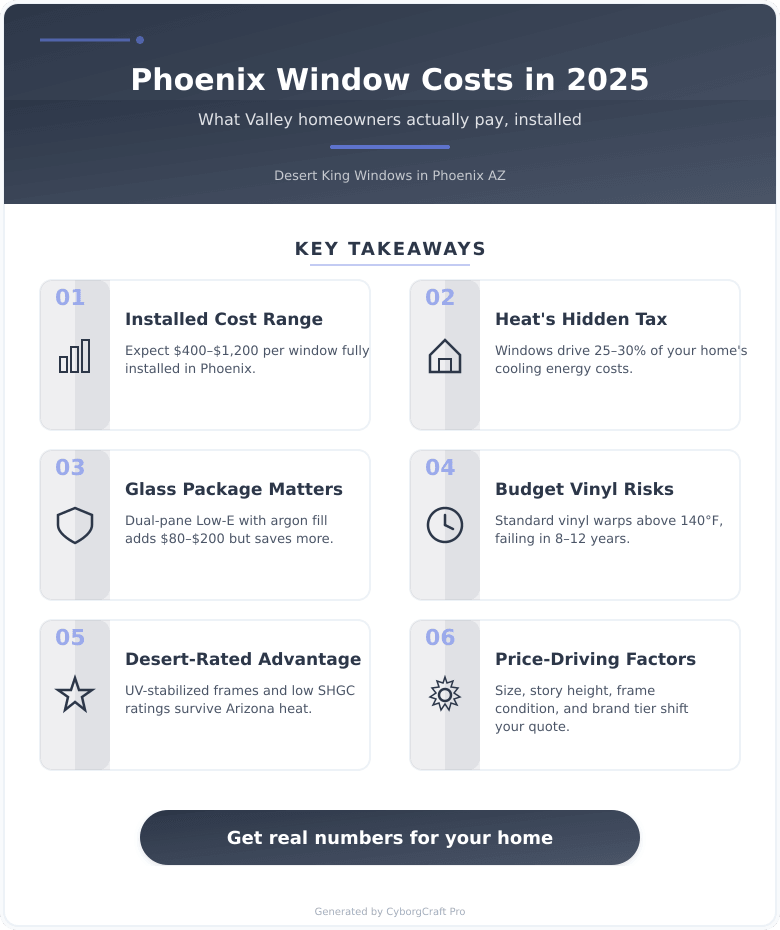
This guide focuses specifically on replacement window pricing for Phoenix, Scottsdale, and East Valley homeowners in 2025 who want honest numbers before talking to a contractor.
Replacement Windows Definition: Replacement windows are factory-built window units installed into existing frames without structural demolition, designed to restore energy performance, reduce air leakage, and update the appearance of an existing home.
The most common mistake we see is homeowners anchoring to a per-window price from a big-box store without accounting for installation, glass upgrades, or Arizona-specific performance specs. A $299 window becomes a $700 installed window fast. And if it lacks proper Low-E coating for desert solar gain, you will feel that gap every month on your APS or SRP bill.
What Replacement Windows Actually Cost in Phoenix in 2025
Here is a realistic breakdown of what Valley homeowners are paying this year. These are full installed costs, not just material prices.
| Window Type | Installed Cost (2025) | Frame Material | Best For |
|---|---|---|---|
| Budget single-hung vinyl | $350 – $550 | Standard vinyl | Rental properties, quick replacements |
| Mid-range double-hung vinyl | $550 – $850 | Reinforced vinyl | Most Phoenix suburban homes |
| Premium desert-rated vinyl | $800 – $1,200 | High-grade vinyl with UV stabilizers | Scottsdale, Paradise Valley, performance buyers |
| Fiberglass or composite | $900 – $1,500 | Fiberglass | High-end homes, custom sizes |
| Wood-clad or aluminum clad | $1,200 – $2,000+ | Wood/aluminum | Historic or luxury homes only |
According to the U.S. Department of Energy, heat gain and loss through windows account for 25 to 30 percent of residential heating and cooling energy use. In Phoenix, where cooling runs 8 to 10 months a year, that percentage hits harder than in almost any other U.S. market.
What Drives the Price Up or Down in the Valley
Several factors push your quote higher or lower. Understanding these helps you read a contractor’s bid without guessing.
- Glass package – basic clear glass vs. dual-pane Low-E with argon fill adds $80 to $200 per window
- Window size – oversized or custom dimensions cost 30 to 60 percent more than standard sizes
- Frame condition – rotted or out-of-square frames add prep labor, often $75 to $150 per window
- Story height – second-floor windows require scaffolding or extended ladders, adding labor cost
- Number of windows – larger projects typically earn per-unit discounts of 10 to 20 percent
- Brand tier – budget brands like Simonton’s entry line vs. premium desert-rated brands like Anlin or Milgard Tuscany differ significantly in long-term performance
Thinking about this for your home? Let’s talk. Contact us and we’ll walk you through your options with real numbers – no pressure, no vague estimates.
Budget Vinyl vs. Premium Desert-Rated Windows: Which Approach Works?
Where budget vinyl succeeds: Lower upfront cost, widely available, acceptable for mild climates or short-term ownership plans.
Where budget vinyl fails: Standard vinyl compounds soften and warp above 140 degrees Fahrenheit – a temperature common on west-facing Phoenix walls in July. Seals fail sooner, frames bow, and hardware loosens. You may replace them again within 8 to 12 years.
Where premium desert-rated windows succeed: Formulated with titanium dioxide UV stabilizers and reinforced chambers, these frames hold shape at sustained high heat. Better Low-E coatings reduce solar heat gain coefficients (SHGC) to 0.22 or lower, which is critical for Arizona south and west exposures.
Where premium windows fail: Higher initial investment can strain tight budgets. Not every home or every window position needs the top-tier spec – a north-facing bathroom window does not carry the same load as a west-facing living room picture window.
The verdict: For Phoenix, Scottsdale, and the East Valley, mid-range to premium desert-rated vinyl is the right call for south and west exposures. Budget vinyl on protected north and east windows where solar gain is minimal is a reasonable cost-saving compromise most contractors will confirm.
Arizona Tax Credits and Rebates Worth Knowing in 2025
The federal Energy Efficient Home Improvement Credit (25C) covers 30 percent of qualifying window costs, up to $600 per year for windows (2025 limits). To qualify, windows must meet ENERGY STAR Most Efficient criteria, which typically means a U-factor of 0.27 or lower and SHGC of 0.22 or lower for Arizona’s climate zone.
SRP and APS both offer rebate programs for qualifying window replacements. SRP’s current rebate runs approximately $4 per window for ENERGY STAR certified products. Check each utility’s website directly for current eligibility since these programs update annually.
Your Replacement Window Action Plan
- Step 1 – Audit your exposures: Walk your home and note which windows face south and west. These need the highest-performing glass package. North and east windows can use a mid-tier spec.
- Step 2 – Get three written bids: Each bid should itemize labor, materials, brand, and glass specs separately. A single lump-sum quote is a red flag.
- Step 3 – Verify contractor licensing: Arizona requires a ROC (Registrar of Contractors) license for window installation. Verify at the Arizona Registrar of Contractors before signing anything.
- Step 4 – Confirm ENERGY STAR specs: Ask for the NFRC label data on the proposed window. U-factor and SHGC numbers should be on the label, not estimated verbally.
- Step 5 – Schedule for fall or spring: Phoenix window installs move faster and with fewer weather interruptions in October through April. Summer scheduling often means longer lead times.
Pre-Installation Checklist
- ☐ Confirm contractor ROC license number and check it online
- ☐ Verify contractor carries general liability and workers’ comp insurance
- ☐ Get written spec sheet for brand, series, U-factor, and SHGC
- ☐ Confirm permit requirements with your city (Phoenix, Scottsdale, Mesa, Chandler, Gilbert all have their own processes)
- ☐ Review warranty terms – look for at least a 10-year frame warranty and lifetime glass seal warranty
- ☐ Save ENERGY STAR certification documents for your 25C tax credit claim
Key Takeaways for Valley Homeowners in 2025
- Full installed cost ranges $400 to $1,200 per window – material-only prices are misleading without labor and glass package included
- SHGC matters more than price in Phoenix – a window rated 0.22 SHGC or lower is worth paying more for on south and west walls
- Federal 25C credit covers 30 percent of qualifying window costs up to $600 annually, reducing your real out-of-pocket cost
- Verify your contractor’s ROC license before signing – unlicensed installs void manufacturer warranties in Arizona
- Desert King Windows serves homeowners throughout Phoenix, Scottsdale, Mesa, Chandler, Gilbert, Tempe, and surrounding East Valley communities
Frequently Asked Questions
How much do replacement windows cost per window in Phoenix in 2025?
Most Phoenix homeowners pay $400 to $1,200 per window fully installed in 2025. The wide range reflects differences in window size, glass package quality, frame material, and labor complexity. Desert-rated premium vinyl with Low-E glass sits at the higher end and is typically worth it for south and west-facing windows.
Do I need a permit to replace windows in Phoenix or Scottsdale?
Most like-for-like window replacements in Phoenix do not require a permit, but this varies by city and project scope. Scottsdale, Chandler, and Mesa each have slightly different rules. Your contractor should confirm permit requirements before starting – any structural changes or size alterations almost always require one.
What SHGC rating do I need for Arizona windows?
ENERGY STAR recommends an SHGC of 0.25 or lower for Arizona’s hot-dry climate zone, and many desert-performance windows hit 0.22 or below. The lower the SHGC number, the less solar heat passes through the glass – a critical spec for south and west exposures in the Valley.
How long does a window replacement project take?
Most whole-home replacement window projects in the Valley take one to three days for installation once product arrives. Lead times for manufacturing and delivery run two to six weeks depending on brand and customization. Scheduling in fall or spring typically shortens wait times.
Can I claim a tax credit for new windows in Arizona?
Yes – the federal Energy Efficient Home Improvement Credit (25C) covers 30 percent of qualifying window costs, up to $600 per tax year in 2025. Windows must meet ENERGY STAR Most Efficient criteria. Keep your NFRC label documentation for your tax filing.
How do I know if my windows need replacing vs. repairing?
Replace rather than repair when you feel heat radiating through closed windows, notice fogging between glass panes, or find frames that no longer close flush. Cracked glazing, failed seals, or frames soft to the touch from UV degradation are also clear replacement indicators.
Your Next Step
Replacement window costs in Phoenix are straightforward once you know what questions to ask and what specs matter most for the desert climate. The difference between a window that performs for 25 years and one that softens and leaks in eight comes down to glass specs and frame quality – not brand names or contractor sales pitches.
Desert King Windows in Phoenix AZ serves homeowners throughout Phoenix, Scottsdale, Mesa, Chandler, Gilbert, Tempe, and the surrounding East Valley. We keep quotes itemized, transparent, and tied to real product spec sheets so you know exactly what you are buying before you sign. Visit our services page for a full overview of what we offer.
Ready to get real numbers for your home? Contact us today – we will walk through your window count, exposures, and options and give you an honest estimate based on your actual situation, not a one-size-fits-all pitch.