
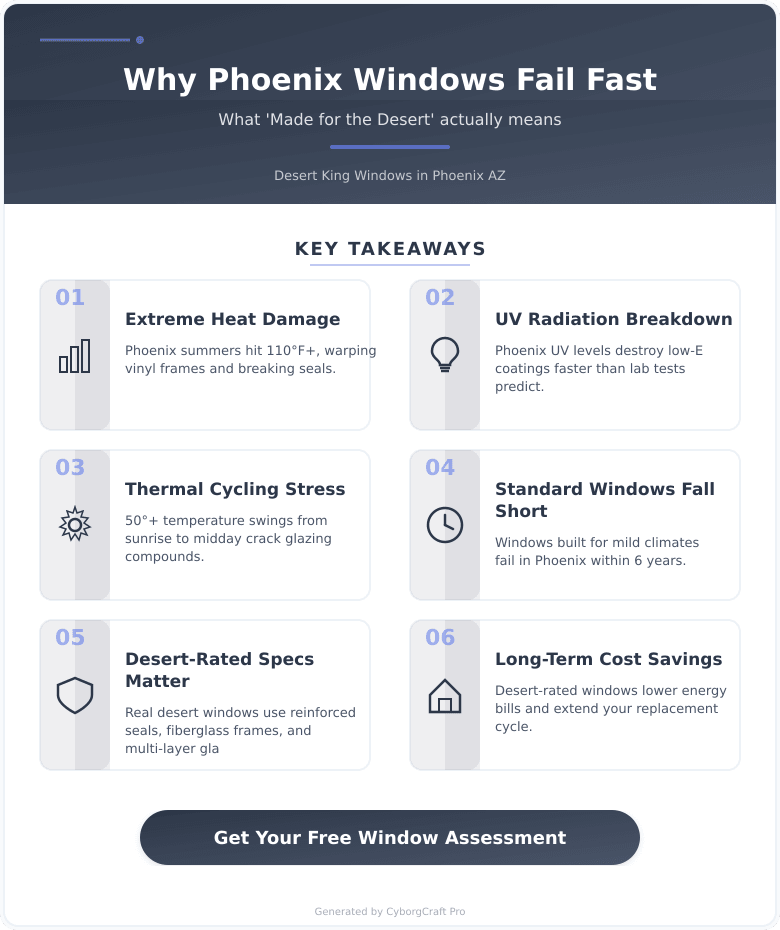
This guide focuses specifically on why Phoenix homeowners experience accelerated window failure and what genuine desert-rated performance looks like in practice.
Desert Window Performance Definition: A window rated for desert climates is engineered to resist sustained temperatures above 110 degrees Fahrenheit, UV index levels that regularly exceed 11, and thermal cycling that can shift frame temperatures by 50+ degrees between sunrise and midday.
What Phoenix Actually Does to a Standard Window
Most windows sold across the country are designed for moderate climates. They’re tested in conditions that don’t come close to a Phoenix July. Here’s what your windows face every single summer in Arizona.
According to the U.S. Department of Energy, solar heat gain through windows is one of the largest contributors to cooling costs in hot climates. In Phoenix, that’s not a seasonal issue – it’s a 9-month-a-year problem.
- Vinyl frames expand and contract repeatedly in 110-plus-degree heat, causing warping and seal failure
- UV radiation at Phoenix intensity degrades window films, tints, and low-E coatings faster than manufacturers’ lab tests predict
- Thermal stress can crack glazing compounds and compromise dual-pane gas fills, particularly in lower-grade units
- Direct sun exposure on west and south-facing windows drives glass surface temperatures to extreme levels
- Monsoon humidity cycling accelerates frame oxidation and caulk breakdown after the dry heat sets it up for failure
Building science research consistently shows that windows in IECC Climate Zone 2B – where Phoenix sits – experience accelerated failure compared to the same products installed in temperate zones. That tracks with what crews replace in Phoenix neighborhoods every year.
The most common mistake we see is homeowners buying windows based on price alone, installing a product rated for the Pacific Northwest or Midwest, and wondering why the seals fog over by year six.
Standard Windows vs. Desert-Rated Windows: Which Approach Works?
Where standard windows succeed: Lower upfront cost, widely available, acceptable performance in mild climates, and many attractive style options.
Where standard windows fail: Seal integrity degrades faster in sustained heat, frame warping causes operational problems within a few years, and low-E coatings break down under Phoenix UV levels, reducing energy performance exactly when you need it most.
Where desert-rated windows succeed: Engineered vinyl or fiberglass frames that tolerate thermal cycling, multi-layer low-E glazing designed for high-solar zones, argon or krypton gas fills with reinforced edge seals, and hardware that won’t bind or corrode in dry heat.
Where desert-rated windows fail: Higher initial investment, fewer budget-tier options, and some products marketed as desert-rated don’t actually carry the performance specs to back up the claim.
The verdict: For a Phoenix home, desert-rated windows pay for themselves through lower energy bills and a longer replacement cycle. A standard window installed here is a short-term decision with long-term costs. Ask any contractor replacing windows in Ahwatukee or Maryvale – they’ll tell you the same thing.
Thinking about this for your home? Let’s talk. Contact us and we’ll walk you through your options – no pressure.
What ‘Made for the Desert’ Actually Has to Mean
Plenty of window companies use desert-adjacent marketing language. But real desert performance comes down to measurable specs, not slogans. Here’s what to look for.
Solar Heat Gain Coefficient (SHGC): A number between 0 and 1 measuring how much solar radiation passes through the glass. For Phoenix, look for SHGC at or below 0.25 on south and west exposures.
U-Factor: Measures heat transfer through the window assembly. Lower is better. Desert-appropriate U-factor ratings run 0.25 or below for adequate insulation against both heat and the occasional cold snap.
Low-E Coating Grade: Not all low-E coatings are equal. Hard-coat low-E is more durable but less efficient. Soft-coat low-E performs better but requires proper sealing to survive Phoenix conditions. Ask which type is in the window you’re buying.
Brand Comparison: Desert Performance at a Glance
| Brand / Series | Frame Material | SHGC Range | Warranty | Price Range (2025) | Best For |
|---|---|---|---|---|---|
| Anlin Malibu | Vinyl | Contact dealer for specs | Contact dealer for details | Contact dealer for pricing | Desert heat performance |
| Milgard Tuscany | Vinyl | Contact dealer for specs | Contact dealer for details | Contact dealer for pricing | Value in hot climates |
| Pella 250 Series | Vinyl/composite | 0.23-0.30 | Limited lifetime | $500-$950/window | Mid-range desert use |
| Andersen 400 Series | Wood/composite | 0.25-0.32 | 20-year | $600-$1,100/window | Aesthetics with moderate heat resistance |
| Simonton Reflections | Vinyl | 0.21-0.27 | Limited lifetime | $380-$800/window | Budget-conscious desert upgrade |
Prices reflect installed cost estimates as of 2025. Actual quotes vary by home configuration and scope of project.
Your Phoenix Window Replacement Action Plan
- Step 1 – Assess Current Windows: Check for fogged panes, warped frames, sticky operation, and visible UV damage to seals. These are signs of failure already in progress.
- Step 2 – Measure Solar Exposure: Identify which windows face south and west – those face the most intense heat load and need the lowest SHGC ratings.
- Step 3 – Set a Budget Range: Factor in installation, permits (check with the City of Phoenix regarding permit requirements for your specific project), and disposal fees. Typical full-home replacement in Phoenix runs $8,000-$22,000 in 2025 depending on home size and product tier.
- Step 4 – Request Desert-Specific Specs: Ask any contractor to provide SHGC and U-factor data in writing before signing anything. If they can’t produce it, move on.
- Step 5 – Check for Rebates: APS and SRP both offer energy efficiency rebates in 2025. Federal tax credits under the Inflation Reduction Act cover up to 30% of qualifying window costs, capped at $600 per year (2025 limits). Check eligibility before purchasing.
- Step 6 – Verify Contractor Credentials: Arizona requires a licensed contractor (ROC license) for window replacement work. Verify at the Arizona Registrar of Contractors before any work begins.
Common Mistakes Phoenix Homeowners Make
- Buying windows based on national brand reputation without checking desert-specific ratings
- Skipping the permit process to save time – this creates problems at resale
- Installing the same product on north-facing and west-facing windows without adjusting SHGC
- Choosing frame color without checking manufacturer heat tolerance – dark frames absorb significantly more heat
- Accepting verbal warranty claims without reading the fine print on coverage for heat-related seal failure
At Desert King Windows in Phoenix AZ, we see these situations regularly when homeowners come to us after a previous installation didn’t hold up. The fix is always more expensive than getting it right the first time.
Ready to take the next step? Contact us today for straight answers and real solutions. We serve homeowners throughout Phoenix and surrounding communities including Scottsdale, Tempe, Chandler, Gilbert, Glendale, Peoria, and Avondale.
Key Takeaways for Phoenix Homeowners in 2025
- Climate zone matters – Phoenix sits in one of the most demanding thermal environments for windows in the entire country
- SHGC is the number to watch – target 0.25 or below on high-exposure sides of your home
- Frame material affects longevity – fiberglass and quality vinyl outperform wood composites in sustained heat
- Rebates are available right now – 2025 federal and utility credits can offset a meaningful portion of replacement cost
- Permits protect you – unpermitted work creates title and insurance complications that show up at the worst possible time
Frequently Asked Questions
How long do windows typically last in Phoenix compared to other cities?
In Phoenix, standard windows often fail well before they would in moderate climates. The combination of UV intensity, sustained heat, and thermal cycling accelerates every failure mechanism a window has. Desert-rated products with proper specs can extend that lifespan considerably.
What SHGC rating do I need for a Phoenix home?
For south and west-facing windows in Phoenix, target an SHGC of 0.25 or lower. North-facing windows can tolerate slightly higher values. The lower the number, the less solar heat enters your home, which directly reduces cooling costs.
Does Arizona offer rebates for window replacement in 2025?
Yes – both APS and SRP offer energy efficiency rebates, and federal tax credits cover up to 30% of qualifying window costs (capped at $600 annually under 2025 limits). Eligibility depends on the product’s energy performance ratings, so always confirm specs before purchasing.
Do I need a permit to replace windows in Phoenix?
Permit requirements vary by project scope, so check with the City of Phoenix directly before beginning any window replacement work. Work done without required permits can create complications with homeowner’s insurance and property resale. Always use a licensed ROC contractor for this work.
Is vinyl or fiberglass better for Phoenix windows?
Both can perform well in desert heat, but fiberglass frames generally handle thermal cycling with less expansion and contraction than vinyl. High-grade vinyl products from manufacturers who design for hot climates can also perform reliably – the key is checking the spec sheet, not just the material label.
How can I tell if my current windows are failing?
Fogged or cloudy glass between panes, sticky or difficult operation, visible seal gaps, and noticeably higher cooling bills are all signs of window failure. In Phoenix, these symptoms often appear earlier than homeowners expect, especially on south and west exposures.