

Patio Door Replacement in the Valley – Why Sliding Glass Doors Are the Biggest Heat Gain Problem in Most Arizona Homes
Patio door replacement in the Valley is the process of removing outdated or underperforming sliding glass doors and installing thermally efficient alternatives suited to Arizona’s extreme climate. In a region where summer temperatures regularly exceed 115 degrees, the right patio door can mean the difference between a cool home and an AC system that never stops running.
This guide focuses specifically on why sliding glass doors cause disproportionate heat gain in Phoenix-area homes, what replacement options actually perform in desert conditions, and how to choose the right product before another brutal summer hits.
Patio Door Replacement Definition: The full removal and installation of an exterior sliding or hinged glass door system, including frame, glazing, hardware, and weatherstripping, designed to meet current thermal performance and building code standards.
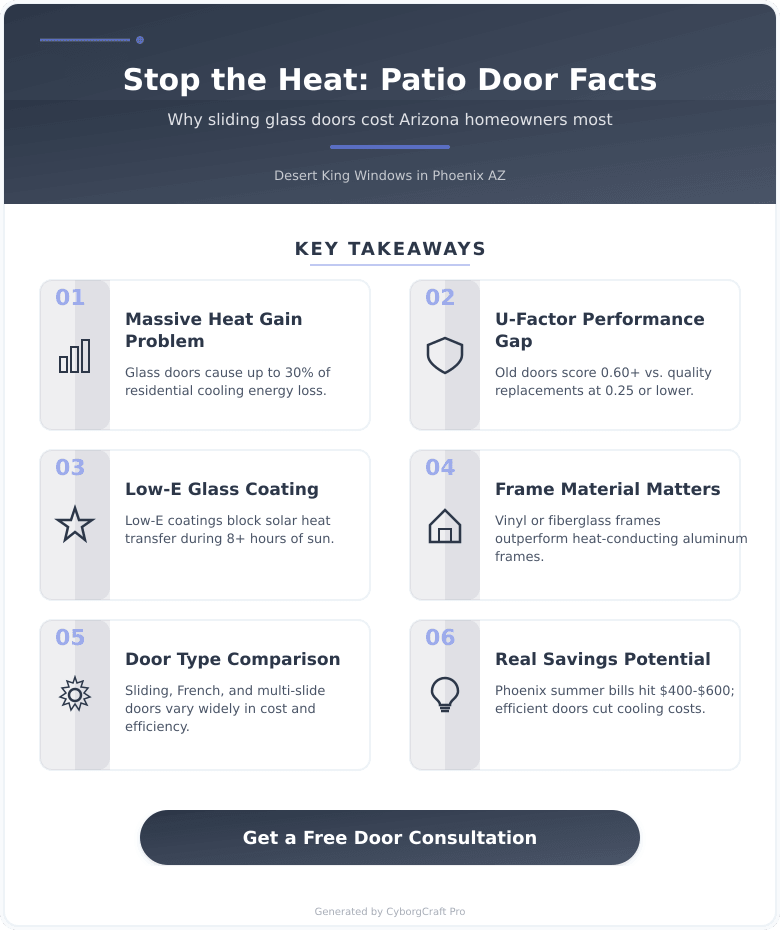
The most common mistake we see is homeowners replacing everything except the patio door. They upgrade their windows, add attic insulation, and still wonder why their cooling bills stay high. A single standard sliding glass door can have a U-factor above 0.60, while a quality replacement door reaches 0.25 or lower. That gap matters enormously in Phoenix, AZ.
Why Sliding Glass Doors Lose the Heat Battle in Arizona
Standard sliding glass doors were not designed with the Sonoran Desert in mind. Most older units use single-pane or basic double-pane glass without low-emissivity (Low-E) coatings. When the sun hits that glass at a direct angle for eight or more hours a day, it transfers heat directly into your living space.
According to the U.S. Department of Energy, windows and glass doors account for up to 30% of residential heating and cooling energy use. In Arizona’s climate, sliding glass doors often represent a larger share of that figure than any single window in the home.
Here is what makes them especially problematic:
- Large surface area – most doors span 60 to 72 inches wide
- Direct western or southern exposure in most Valley home layouts
- Older frames with aluminum construction that conducts heat rapidly
- Worn weatherstripping that allows hot air infiltration around the edges
- No solar heat gain coefficient (SHGC) protection in pre-2005 units
According to ENERGY STAR, homes in hot climates that replace single or low-performance glass doors with certified products can achieve meaningful reductions in cooling costs. In Phoenix, where summer utility bills can reach $400-$600 per month, that adds up fast.
Thinking about this for your home? Let’s talk. Contact us and we will walk you through your options with no pressure.
Sliding Glass Door vs. French Door vs. Multi-Slide: Which Performs Best?
Where traditional sliding glass doors succeed: Low upfront cost ($800-$2,000 installed), easy operation, wide availability, and familiar aesthetics for most Valley homeowners.
Where traditional sliding glass doors fail: Poor thermal performance in older configurations, limited frame material options at the budget tier, and a tendency for tracks to warp under extreme heat cycles.
Where French doors succeed: Better air sealing potential, stronger framing options, and a more architecturally detailed look that can increase resale value in Scottsdale and Paradise Valley homes.
Where French doors fail: Higher cost at the premium tier, swing clearance requirements that limit furniture placement, and less glass area for natural light if that matters to you.
The verdict: For most Phoenix-area homeowners focused on heat gain reduction, a high-performance sliding glass door with Low-E glass and a vinyl or fiberglass frame outperforms an older French door at a lower price point. Multi-slide systems offer the best thermal performance and aesthetics but carry the highest cost.
| Door Type | Cost Range (2025) | U-Factor | Best For |
|---|---|---|---|
| Standard Sliding Glass | $800 – $2,000 | 0.35 – 0.60 | Budget replacement |
| High-Performance Sliding | $1,800 – $3,500 | 0.22 – 0.30 | Energy savings focus |
| French Door | Varies by configuration | Varies by glass package | Design-forward homes |
| Multi-Slide System | $4,000 – $10,000+ | 0.20 – 0.28 | Premium performance |
Top Brands for Patio Door Replacement in Phoenix
| Brand | Product Line | Price Range | Warranty | Best For |
|---|---|---|---|---|
| Anlin | Malibu Series | Contact for current pricing | Lifetime | Desert performance |
| Milgard | Tuscany Series | $1,600 – $3,000 | Full lifetime | Value + durability |
| PGT Innovations | WinGuard Series | $2,000 – $4,000 | Limited lifetime | Impact + heat |
| Andersen | 400 Series | $2,200 – $4,500 | 20-year | Classic aesthetics |
| Simonton | Reflections 5500 | $1,500 – $2,800 | Lifetime | Budget-conscious |
Your Patio Door Replacement Action Plan
- Step 1 – Assess current performance: Check your door’s age, frame material, and glass type. Any aluminum-frame door over 15 years old is almost certainly underperforming in today’s heat.
- Step 2 – Measure the opening: Standard rough openings run 60″, 72″, or 96″ wide. Confirm yours before getting quotes to avoid surprises.
- Step 3 – Select glass specifications: Look for a Solar Heat Gain Coefficient (SHGC) below 0.25 and a U-factor under 0.30 for Phoenix conditions.
- Step 4 – Choose frame material: Vinyl frames resist heat transfer and won’t corrode. Fiberglass costs more but handles expansion cycles better in extreme climates.
- Step 5 – Pull the permit: The City of Phoenix requires a permit for patio door replacement when structural changes occur. Confirm requirements at the Phoenix Development Services Department before work begins.
- Step 6 – Schedule installation: Spring and fall offer the best installation windows. Summer heat affects sealant curing times and makes the job harder on crews.
See how our approach compares – explore our patio door services to review what we carry and how we install.
Permits, Incentives, and What to Gather Before Your Appointment
- ☐ Current door measurements (width x height of the opening)
- ☐ Photos of existing door, frame, and threshold condition
- ☐ Most recent APS or SRP utility bill (for rebate verification)
- ☐ HOA approval if required in your community
- ☐ Homeowner’s insurance policy number for project documentation
For 2025, Arizona homeowners can claim the federal energy-efficient home improvement credit (25C) for qualifying exterior doors, up to $250 per door or $500 total per year. The door must meet ENERGY STAR Most Efficient criteria. Confirm current eligibility at the ENERGY STAR federal tax credits page.
APS and SRP both offer rebate programs for qualifying upgrades. As of early 2025, amounts vary by product and account status, so check directly with your utility before purchasing.
Key Takeaways for Valley Homeowners in 2025
- Heat gain is real and measurable – older sliding glass doors contribute up to 30% of a home’s cooling load
- Frame material matters as much as glass – aluminum frames conduct heat; vinyl and fiberglass don’t
- SHGC under 0.25 is the target for Phoenix – this spec keeps solar heat outside where it belongs
- Federal tax credits are available in 2025 – up to $500 for qualifying door replacements
- Spring is the best time to act – before peak demand drives up contractor wait times heading into summer 2025
Frequently Asked Questions
How much does patio door replacement cost in Phoenix in 2025?
Most Phoenix homeowners pay between $1,500 and $4,000 for a complete patio door replacement, including labor. Premium multi-slide systems can exceed $8,000. Frame material, glass package, and door size are the main cost drivers.
Do I need a permit for patio door replacement in Phoenix?
A permit is typically required when structural modifications accompany the replacement, such as widening the opening. Straight swaps within the same rough opening often qualify as a like-for-like replacement. Always confirm with the City of Phoenix Development Services Department before starting work.
What SHGC rating should I look for in Arizona?
An SHGC of 0.25 or lower is the practical target for homes in the Phoenix, AZ area. Lower SHGC means less solar heat enters through the glass, which directly reduces your air conditioning load during summer months.
How long does patio door replacement take?
Most single sliding door replacements take four to six hours for a professional installation crew. Multi-panel or custom-sized openings may require a full day. Lead times for special-order doors can run two to four weeks in 2025.
What is the best frame material for sliding glass doors in the desert?
Vinyl frames are the most practical choice for Phoenix-area homes because they resist heat transfer and won’t corrode from hard water or sun exposure. Fiberglass handles thermal expansion cycles slightly better but costs 20-30% more.
Can patio door replacement lower my utility bill?
Yes – replacing an older aluminum-frame sliding door with a Low-E vinyl unit typically reduces cooling costs in hot climates. Homes with western or southern exposure see the largest gains because those orientations receive the most direct afternoon sun.
What This Means for Your Home This Summer
If you have an older sliding glass door facing west or south, you are paying more to cool your home than you need to. The technology to fix it is affordable, the tax credits are available right now in 2025, and the installation process is straightforward when you work with someone who knows desert conditions.
At Desert King Windows in Phoenix AZ, we serve homeowners throughout Maricopa County, including Scottsdale, Tempe, Mesa, Chandler, Gilbert, Glendale, Peoria, and surrounding communities. Our location at 2615 S 21st St, Phoenix, AZ 85034 keeps us close to the Valley homes we work in every day.
Ready to stop cooling the outdoors? Contact us today for straight answers and a free estimate on patio door replacement options that actually work in Arizona heat.
Recent posts
 Vinyl vs. Fiberglass Windows in Arizona: An Honest Desert ComparisonSeptember 28, 2026
 Why Vinyl Windows Are the Smart, Low-Maintenance Choice for Las Vegas HomesSeptember 25, 2026
 Entry-Door Replacement in Phoenix: Curb Appeal That Can Take 115 DegreesSeptember 21, 2026
 The Federal Window Tax Credit Ended – How Las Vegas Homeowners Can Still Save in 2026September 18, 2026