
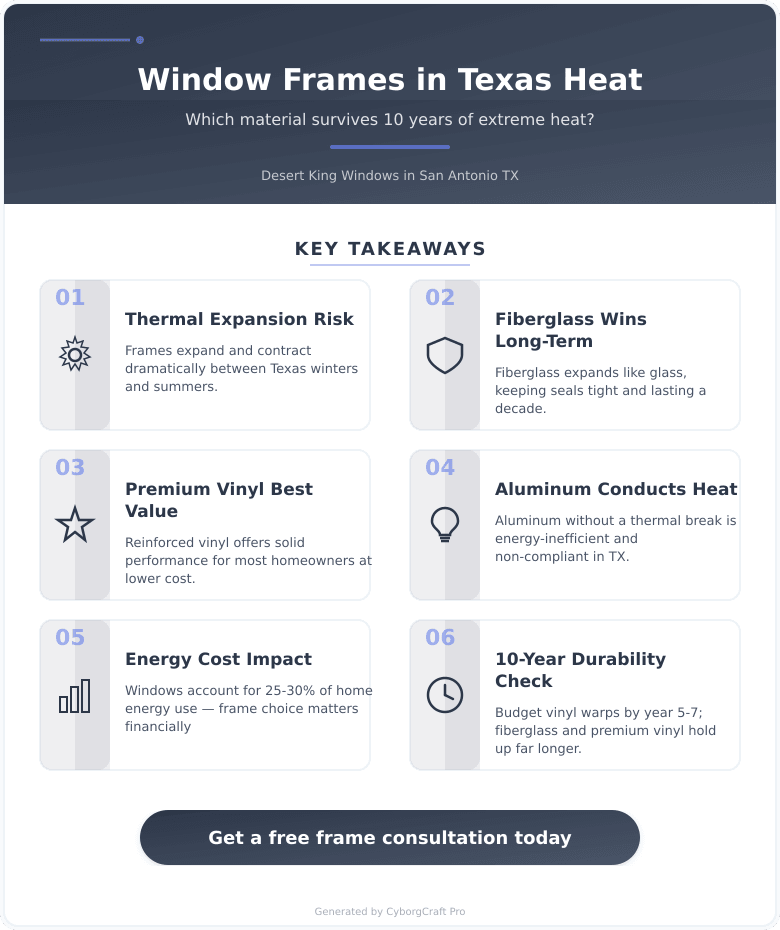
This guide focuses specifically on how vinyl, fiberglass, and aluminum window frames perform in Texas heat conditions over a 10-year lifespan.
Frame Material Definition: Window frame material refers to the structural component surrounding the glass unit, responsible for thermal insulation, structural rigidity, weatherproofing, and long-term dimensional stability under temperature extremes.
Texas summers are brutal. Prolonged stretches above 100 degrees, intense UV exposure, and wild temperature swings between seasons put window frames through punishment that most northern climates never see. According to the U.S. Department of Energy, windows account for 25-30% of residential heating and cooling energy use, making frame material choice a real financial decision, not just a cosmetic one.
At Desert King Windows in San Antonio TX, we see what a decade of Texas heat actually does to different frame materials. Here is what the evidence shows.
How Each Frame Material Handles Extreme Heat
Frame materials respond differently to heat. The core issue is thermal expansion, the physical expansion and contraction of materials as temperatures rise and fall. In San Antonio, frames can swing from 30 degrees on a January night to 105 degrees on a July afternoon. That range matters.
Vinyl frames expand and contract significantly. Standard vinyl has a high coefficient of thermal expansion, meaning it moves a lot. Budget vinyl frames start warping and pulling away from the wall after several years of this cycle. Premium virgin vinyl with reinforced chambers performs considerably better, but it still moves more than fiberglass.
Fiberglass frames expand at nearly the same rate as glass, which is the key technical advantage. That compatibility means seals stay tight over time. The glass unit and frame move together instead of fighting each other. Fiberglass also resists UV degradation better than vinyl, which matters in Texas where sun exposure is relentless.
Aluminum frames are structurally strong but thermally problematic. Aluminum conducts heat efficiently, which is exactly the wrong property for a window frame in a hot climate. Without a thermal break (an insulating barrier inside the frame), aluminum frames act as heat conductors straight into your home. Aluminum frames without thermal breaks are essentially not code-compliant for energy efficiency in most residential Texas applications as of 2025.
Vinyl vs. Fiberglass vs. Aluminum: Head-to-Head Comparison
| Frame Type | Cost Per Window (2025) | Thermal Performance | 10-Year Durability in TX Heat | Best For |
|---|---|---|---|---|
| Standard Vinyl | $250-$450 | Moderate (U-factor 0.30-0.40) | Fair – warping risk after year 5-7 | Budget replacements, rentals |
| Premium Vinyl | $400-$700 | Good (U-factor 0.25-0.32) | Good with quality reinforcement | Most homeowners seeking value |
| Fiberglass | $600-$1,100 | Excellent (U-factor 0.20-0.28) | Excellent – minimal expansion issues | Long-term durability, high-end homes |
| Aluminum (no thermal break) | $200-$380 | Poor (U-factor 0.50+) | Poor for energy; structurally durable | Commercial, garages, non-conditioned spaces |
| Aluminum (thermal break) | $450-$800 | Moderate (U-factor 0.30-0.38) | Good structurally; moderate energy | Modern aesthetic, coastal or commercial |
Vinyl vs. Fiberglass: Which Approach Actually Works?
Where vinyl succeeds: Lower upfront cost, wide color availability, easy maintenance, and good performance when you choose reinforced multi-chamber frames from brands like Simonton, Jeld-Wen, or Alside. Premium vinyl holds up well through a Texas decade when properly installed.
Where vinyl fails: Budget vinyl warps under sustained heat. Color choices are more limited than painted fiberglass. Vinyl cannot be painted later if you want a style change.
Where fiberglass succeeds: Milgard Tuscany and Integrity Wood-Ultrex fiberglass lines are paintable, dimensionally stable, and carry some of the best seal retention rates in hot climates. Fiberglass frames outlast vinyl in head-to-head longevity comparisons. They also carry stronger warranty terms from most manufacturers.
Where fiberglass fails: Higher upfront cost. Fewer contractors stock fiberglass routinely, so lead times can stretch in busy seasons. Repairs are more difficult than vinyl if damage occurs.
The verdict: For most San Antonio homeowners replacing windows in 2025, premium vinyl is the practical choice. Fiberglass is worth the premium for anyone planning to stay in the home 15 or more years, or for homes where energy performance is a top priority. Aluminum without a thermal break has no place in a conditioned Texas living space.
Thinking about this for your situation? Let us talk. Contact us and we will walk you through your options with zero pressure.
Texas Energy Credits and Rebate Opportunities in 2025
The federal Residential Clean Energy Credit through the Inflation Reduction Act allows homeowners to claim up to 30% of qualifying window costs when the product meets ENERGY STAR Most Efficient criteria, capped at $600 for windows annually (2025 limits). Local utility providers in San Antonio may also offer energy efficiency programs that could apply to qualifying window replacements. Check directly with your utility provider for current program availability, as offerings update annually.
According to ENERGY STAR, windows certified for the South-Central climate zone must meet a U-factor of 0.25 or below and a Solar Heat Gain Coefficient (SHGC) of 0.25 or below to qualify. Texas sits in this zone, so confirm both ratings before purchasing.
Your Window Replacement Action Plan
- Step 1 – Assess existing frames: Look for warping, condensation between panes, drafts, or visible frame separation. Any of these signals that failure is already underway.
- Step 2 – Choose your climate zone specs: Confirm your replacement windows carry an SHGC of 0.25 or below and a U-factor of 0.25 or below for Texas conditions.
- Step 3 – Compare frame materials for your budget: Use the table above as your starting reference. Premium vinyl covers most homes. Fiberglass if you are building long-term.
- Step 4 – Verify contractor credentials: Texas requires window installers to hold a valid TRCCA (Texas Residential Construction Commission Act) compliant license. Ask for proof of liability insurance and confirm permit requirements with Bexar County.
- Step 5 – Request energy performance documentation: Get the NFRC label data in writing before signing any contract.
- Step 6 – Schedule installation before peak summer: Spring installation avoids the hottest install conditions and gets your efficiency gains working before July and August billing cycles.
Common Mistakes That Cost Texas Homeowners Money
- Buying on price alone and selecting budget vinyl without reinforced chambers, which warps within 5-7 years in direct sun exposure.
- Ignoring SHGC ratings and focusing only on U-factor. In Texas heat, solar heat gain is often the bigger energy problem.
- Skipping permits. Unpermitted window replacements complicate home sales and may void manufacturer warranties.
- Choosing aluminum frames without thermal breaks in living spaces, which drives cooling costs up immediately.
- Not asking about Low-E glass coatings alongside frame material. Frame and glass work together. One strong choice without the other still underperforms.
Key Takeaways for Texas Homeowners in 2025
- Fiberglass outlasts vinyl over 10 years – dimensional stability and seal retention in extreme heat give fiberglass a measurable long-term edge.
- Premium vinyl beats budget vinyl significantly – reinforced chambers and virgin vinyl compounds change the durability picture entirely.
- Aluminum without a thermal break is not appropriate for conditioned Texas living spaces in 2025.
- SHGC matters as much as U-factor – target 0.25 or below on both for South-Central climate zone performance.
- Federal tax credits are available now – up to $600 annually for qualifying ENERGY STAR Most Efficient windows (2025 limits).
Frequently Asked Questions
Which window frame material lasts longest in Texas heat?
Fiberglass frames typically last the longest in Texas heat due to their low thermal expansion rate and UV resistance. Premium vinyl with reinforced chambers performs well for most homeowners, but fiberglass carries a measurable durability advantage in sustained high-heat climates over a 10-15 year horizon.
Do vinyl windows warp in Texas summers?
Budget vinyl windows can warp after repeated years of extreme temperature cycling, typically showing issues between years 5 and 7. Premium reinforced vinyl with multi-chamber construction handles Texas heat significantly better and is the standard recommendation for residential replacement windows in the San Antonio area.
Are aluminum windows a bad choice for Texas homes?
Aluminum frames without thermal breaks conduct heat directly into the home and are a poor energy choice for conditioned living spaces in Texas. Thermally broken aluminum performs adequately but still trails fiberglass and premium vinyl in overall energy efficiency for hot-climate residential use.
What SHGC rating do I need for Texas windows?
Texas falls in the South-Central ENERGY STAR climate zone, requiring an SHGC of 0.25 or below for qualifying certification. Solar heat gain is often the primary driver of cooling costs in Texas homes, making SHGC at least as important as U-factor when comparing window options.
How much do replacement windows cost in Texas in 2025?
Replacement window costs in Texas range from roughly $300 to $1,100 per window installed depending on frame material, size, and glass package. Premium vinyl typically falls in the $400-$700 range installed, while fiberglass runs $600-$1,100. Aluminum with thermal breaks falls in the $450-$800 range.
Can I get a tax credit for new windows in Texas?
Yes, qualifying ENERGY STAR Most Efficient windows are eligible for the federal Energy Efficient Home Improvement Credit, up to $600 annually for windows (2025 limits). Windows must meet both U-factor and SHGC requirements for the South-Central climate zone to qualify. Consult a tax professional for application guidance.
What This Means for Your Home
Ten years goes fast. The frames you install this year will be dealing with hundreds of Texas heat cycles before you think about replacing them again. Getting the material choice right now means lower energy bills, fewer repairs, and no unpleasant surprises when you sell.
The team at Desert King Windows in San Antonio TX, located at 1890 S Brazos St, serves homeowners throughout Bexar County including Alamo Heights, Helotes, Leon Valley, Converse, Schertz, Universal City, and surrounding neighborhoods. We carry premium vinyl and fiberglass options with proper South-Central ENERGY STAR ratings and can walk you through what actually makes sense for your specific home and budget.
Ready to get real answers? Contact us today for a straightforward estimate. No pressure, no runaround, just honest information about what will work for your home. Spring is the right time to move before peak summer heat drives up demand and installation wait times stretch into August.
For a full overview of what we offer, visit our services page and see how we approach window replacement the right way.